Winter storm checklist for Sonoma County homes
Most of the year's rain falls from November to March. Get the house ready now: tap what is done, then print it. Updated October 16, 2026.
Before the rain
If water has come in before
For power outages
Stay informed
0 of 17 done.
Want more to print? Get the full 44-item checklist.
When the big storms come
In the 2025 water year, Santa Rosa got 98% of its rain from November through March [8].
November alone brought 14.72 inches, more than a third of the year.
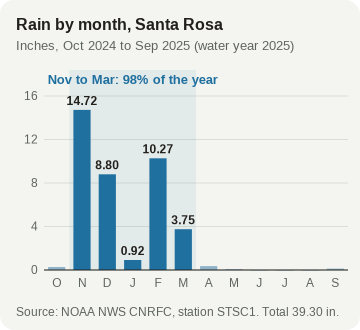
One year is not an average. This one was wetter than normal [8].
Summer was nearly dry, and the storms came in a few winter months. That is why gutters and drains are an October job.
Rain also changes a lot across the county. Our water site, The Downspout, has rain totals town by town.
How much water your roof sheds in a storm
A one-day storm that hits Santa Rosa about every 2 years drops 3.29 inches [9].
On a 2,000 square foot roof, that is about 4,100 gallons. All of it comes down where your downspouts end.
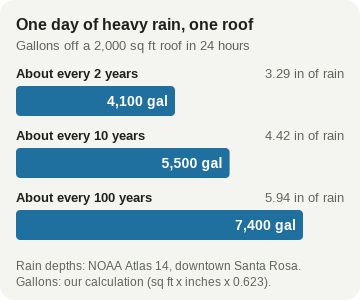
About once every 10 years, 0.85 inches falls in a single hour [9]. That is about 18 gallons a minute off the same roof, on average. Short bursts run harder.
Downspouts need room for that. A common rule is 1 square inch of downspout opening for every 100 square feet of roof [2].
For 2,000 square feet, that is about 20 square inches: at least four standard 2 by 3 inch downspouts.
Your numbers will differ by location. NOAA's map gives storm sizes for any address. Not sure yours keep up? A Storm Ready Plan checks every downspout.
Where the water should go

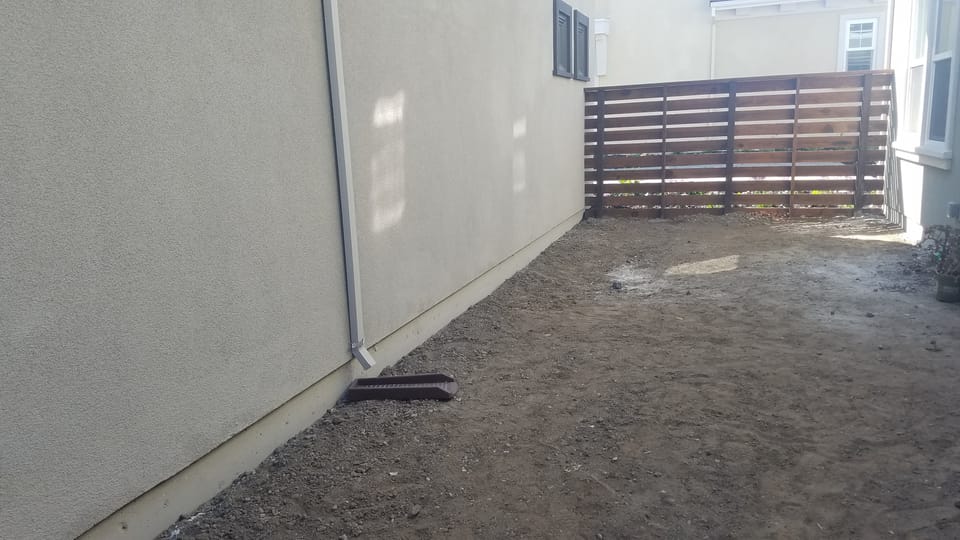
Water that spills over a clogged gutter, or drops right at the wall, soaks the soil against the foundation.
The fixes are usually small: clean gutters, an extension, a splash block, a little soil to slope the ground away [2].
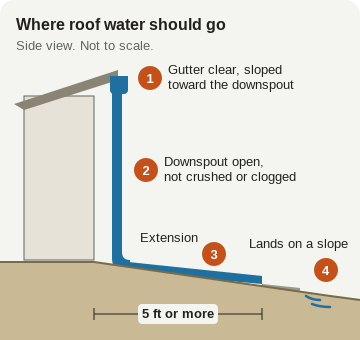
- Gutter: clear, and sloped toward the downspout, at least 1/16 inch per foot
- Downspout: open top to bottom, not crushed or clogged
- Extension: ends at least 5 feet from the foundation
- Landing spot: ground slopes away from the house
Do not send it to a neighbor. In unincorporated Sonoma County, changing how water drains can need a county permit. The Downspout explains when you need one.
What it means for you
- Do gutters and downspouts in October, before the November storms.
- Watch the first real rain. Walk around the house and see where the water goes.
- If water has come in before, find your sandbag station and check flood coverage now. A new policy takes 30 days.
- Sign up for SoCoAlert today. It is free [6].
Sources
- City of Sonoma, "Weather Awareness: Series of Rain Storms Expected Through Christmas Week", December 18, 2025.
- U.S. Department of Energy, Building America Solution Center, "Gutters and Downspouts".
- County of Sonoma, SoCo Emergency, "Sandbags".
- FEMA FloodSmart, "Minimize Flood Damage".
- CDC, "Avoiding Carbon Monoxide Poisoning".
- County of Sonoma, SoCo Emergency, "SoCoAlert".
- FEMA FloodSmart, "Buy a Flood Insurance Policy".
- NOAA National Weather Service, California-Nevada River Forecast Center, Monthly Precipitation Summary, Water Year 2025, updated October 31, 2025.
- NOAA Atlas 14, Volume 6, Precipitation Frequency Data Server. Point estimates for downtown Santa Rosa, latitude 38.4404, longitude -122.7141 (table).
- NOAA Climate Prediction Center, ENSO Diagnostic Discussion, October 8, 2026.
- County of Sonoma, "Sonoma County proclaims emergency, ramps up preparations ahead of potential winter storms", October 6, 2026.
"Our tip" items come from our own work on Sonoma County homes. Charts are our own calculations from the public data named under each one. Last checked October 12, 2026.