Replacing bark mulch next to your house
How much gravel the first 5 feet take, and what to do with the old bark.
The short answer
Pull bark and wood chips back from the walls. Fill the first 5 feet with gravel, rock or pavers instead. UC's Fire Network says combustible mulch is not recommended within 5 feet of a house, and names concrete, gravel, noncombustible rock and pavers as the materials to use there (UC ANR Fire Network).
What the draft rule covers, and its one exception for construction, are on Zone Zero Guidelines. This page is about doing the job.
How much gravel
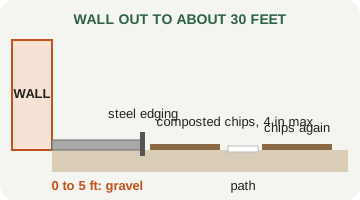
- Rake the old bark out down to bare soil before you lay stone.
- Measure the wall length that the strip runs along, in feet.
- Multiply by 5 (the strip is 5 feet wide), then by the depth in feet (3 inches is 0.25).
- Divide by 27 to get cubic yards.
- Take off any patio, walkway or porch that is already paved. Round up when you order.
| Wall length | 2 in deep | 3 in deep | 4 in deep |
|---|---|---|---|
| 20 ft | 0.6 | 0.9 | 1.2 |
| 40 ft | 1.2 | 1.9 | 2.5 |
| 60 ft | 1.9 | 2.8 | 3.7 |
| 80 ft | 2.5 | 3.7 | 4.9 |
Our arithmetic: length x 5 ft x depth in feet / 27. A supplier can tell you how much one cubic yard of the stone you pick will cover. UC does not set a depth for gravel, so the depth is your call. Ask your supplier what the stone you pick needs.
Keep the stones clean
Gravel does not burn. UC says that if no combustible material or vegetation sits on top of it, no combustion is expected. Leaves and needles that land on the stones are the fuel. FIRESafe MARIN says debris that collects on rocks has to be removed regularly (FIRESafe MARIN).
So plan to sweep or blow the strip off, especially under trees and along the roof edge. Our suggestion: sweep it after the leaves drop, and again before the dry season.
Weed fabric
UC lists landscape fabric, the kind made of polypropylene or polyester, under synthetic mulches, and says organic and synthetic mulches are combustible. It does not say whether fabric buried under gravel counts. We found no source that settles it. Our view: skip the fabric in the first 5 feet if you can, and pull weeds by hand. If you want it, ask your local fire agency first.
What to do with the old bark
- Do not pile it against the house, and do not leave it stacked near the walls.
- 5 to 30 feet out: UC says keep combustible mulch no deeper than 4 inches, not in one continuous layer, and break it up with paths or short stone walls. It recommends composted wood chips or medium bark chips, 1 to 3 inches across, here.
- 30 feet and beyond: UC also recommends shredded cedar or redwood bark and pine needles, with combustible mulch still no deeper than 4 inches.
- Or haul it off. In Sonoma County, see fire resources for the county chipper program.
Do not count on watering the bark to make it safe. UC says not to rely on that near structures, because water may be unavailable during a fire and the mulch dries out quickly.
Edging and where the water goes
UC notes that gravel looks good with noncombustible edging such as steel. We suggest edging to keep the gravel in and the chips out of the strip.
Roof water lands in this strip too. If the downspouts empty onto it, think about where that water goes next. The Downspout, a sister publication, covers when to keep rain on your land and when to drain it.
Sources
- UC ANR Fire Network: Mulch (zone-by-zone mulch advice, checked October 13, 2026)
- FIRESafe MARIN: How to use fire-resistant mulch (checked October 13, 2026)
- Zone Zero Guidelines: bark mulch (what the draft rule says, with the Board of Forestry notice of August 20, 2026)
- California Office of Administrative Law: recent actions (the September 8 withdrawal, file 2026-0828-03E)