Sandbag alternatives for doors and garages
What works instead of sandbags, how well each one holds water back, and which to use where.
The short answer
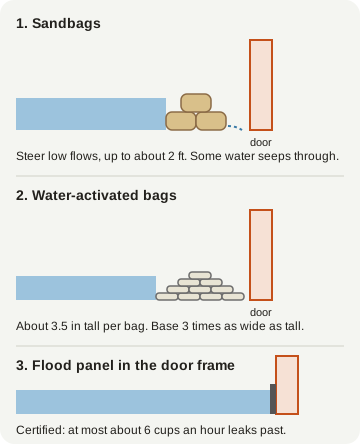
For a door or garage, the two common alternatives are water-activated bags and flood panels that fit the door frame. Water-activated bags are the closest swap: light to store, quick to set out, and good for shallow water, up to about a foot [1]. A certified flood panel is the tightest seal, but it locks into a frame fixed to the sides of the doorway, so it goes on ahead of time [2].
No barrier keeps out every drop. Plan where the water that gets past will go.
A bag that weighs almost nothing until it rains
A water-activated bag looks like a flat pillowcase. Dry, one weighs well under a pound. Soaked, the same bag swells to about 3.5 inches tall and holds about 4 gallons, roughly 32 pounds, by one maker's numbers [3].
That is the whole appeal. You can keep a stack on a garage shelf, carry them with one hand, and skip the trip to a sand pile. They soak up the water in their path, and once full, they act as a short wall [1].
How to set them out
- Soak them first if water will rush in. Wet them with a hose where they will sit, then stack them. The maker says this works better than waiting for the storm to fill them [3].
- Build a pyramid. Make the base three times as wide as the wall is tall, and stack the bags higher than the water you expect [3].
- Fresh water only. Salt water makes the bags give up their water and go flat [3]. That matters at the coast, not for runoff from a hillside.
- Put them out before the rain. Like sandbags, they only work if they are in place first, so decide where they go now [1].
So how many bags does a door take? For water a foot deep, stack four layers, which stands about 14 inches tall. The bottom layer is four bags side by side, about 4 feet from front to back. Each 2-foot stretch of wall then takes 10 bags: 4, 3, 2 and 1. A 3-foot door, with the wall running about 6 inches past each side, takes about 20. That is our math from the maker's sizes, so check it against the bags you buy.
What they can't do
Some water will still get through, and if the water rises over the wall, it comes in anyway. Have a small pump ready for the water that seeps through [1].
Reuse is where sources disagree. The maker says the bags shrink as they dry and work again [3]. Delaware's state environment department says a second soaking often won't swell them to full size, so you may need new bags for each flood [1].
Our take: buy new bags for the doors that matter, because a reused bag may come up short and let water over the top. Save fully dried bags for a spot that only drips. The maker says drying them for storage typically takes 2 to 3 months [3]. Bags that soaked up sewage or chemicals can't be reused, so ask your garbage service how to throw them out [1].
Flood panels: the tight seal
A flood panel slots into a frame fixed to the sides of a doorway. FM Approvals, a product testing and certification company, tests and certifies door and window flood panels [2].
The bar is strict. A certified panel across a 3-foot door, rated for water a foot deep, may leak about 6 cups an hour at most (0.4 gallons) [2].
The catch is that the panel has to match your opening. If a seller calls a panel certified, look for the FM Approvals mark on its nameplate. The nameplate also lists the deepest water the panel is rated for [2].
And plain sandbags?
They still work, and in Sonoma County the sand and bags are set out at county and city sites during storms. Our guide to Sonoma County sandbag sites lists them and shows how to fill and stack. They handle low flows, up to about 2 feet [4], twice what water-activated bags are rated for.
Which one for which spot
- Garage door at the bottom of a driveway: water-activated bags, or sandbags if you have the help to fill them.
- A door that floods every winter: price a flood panel and frame.
- Water in the crawl space: a barrier at the door won't help if water comes up through the ground. The Downspout, our sister site on Sonoma County water, explains how to tell where crawl space water comes from.
- Water running off your own roof: fix that first. See how far downspouts should carry water from the house.
These picks are ours. Our winter storm checklist covers the rest of the house.
What it means for you
- Walk your lot in the next rain and mark the doors water heads for.
- Buy bags for those doors now, not the day a storm is forecast.
- Keep a wet vac where you can reach it, for the water that gets past.
Sources
- Delaware DNREC, I-ADAPT: Water Activated Barrier (Aqua Bags) (how they work, up to one foot, seepage, reuse, disposal; PDF, 2022 cost table, checked November 11, 2026)
- FM Approvals: Examination Standard for Flood Mitigation Equipment, Class 2510 (opening barriers, Appendix D seepage limits, nameplate; PDF, December 2022, checked November 11, 2026)
- Quick Dam: Flood Bags instructions (maker's sizes, weight, stacking, salt water, reuse; PDF, undated, checked November 11, 2026)
- San Mateo County: sandbag instructions (low flows up to 2 feet; PDF, checked November 11, 2026)