Home inventory for insurance in Sonoma County
An hour with your phone now can save weeks of paperwork after a fire. Here is what to record, and what California says about contents claims.
The short answer
A home inventory is a record of what you own: photos or video, what each thing is, and roughly what it cost. You do it before a loss, so you are not trying to remember a whole house from memory afterward.
The CDI says many policyholders find it overwhelming to identify every item they lost after a wildfire (CDI notice, October 2, 2020). A record you made in advance is the easy fix.
Who this applies to
Anyone with homeowners, renters or landlord insurance in Sonoma County. It matters most if you live where wildfire or a big storm could damage the whole house, and if your policy covers contents (personal property) as a percentage of your dwelling limit. Look at your policy declarations page to see your contents limit.
What California says about contents after a total wildfire loss
For a covered total loss in a wildfire state of emergency, state law (AB 3012, 2020) requires insurers to offer a contents payment of no less than 30% of the dwelling limit, up to $250,000, without an itemized inventory (CDI notice). In February 2025 the CDI repeated this and added that you can still recover the full value of destroyed belongings, up to your policy limits, by meeting documentation requirements (CDI press release, February 13, 2025).
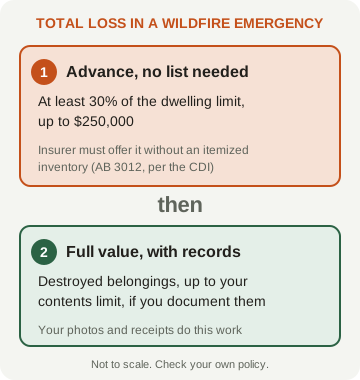
- The advance: at least 30% of the dwelling limit, up to $250,000, with no itemized list.
- The rest: full value up to your contents limit, if you document it.
Our arithmetic, as an example only: a $600,000 dwelling limit gives a 30% advance of $180,000. A $1,000,000 limit would be 30% of $1,000,000, which is $300,000, so the $250,000 cap applies.
The CDI has also asked insurers to go further. In past large fires, many paid 75%, 80% or in some cases 100% of the contents limit without an inventory, and let people recover more later by completing one (CDI notice). That was a request, not a rule, and it is not a promise for your claim.
What this means for you: the inventory is not what gets you started. The advance does that. The inventory is what gets you the rest of your contents limit. Not every loss is a total wildfire loss, and storm, theft or partial fire claims may need your list from the start.
Make yours in an hour
These steps are our tips, not an insurer requirement. Ask your insurer what documentation it accepts.
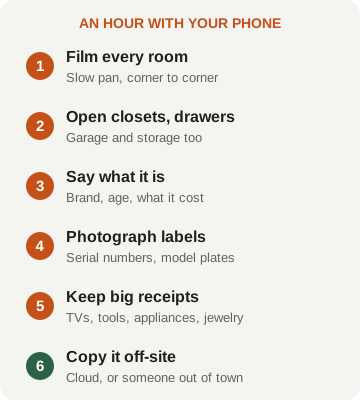
- Film every room with a slow pan.
- Open closets, drawers, the garage and storage.
- Say aloud what things are, their brand, age and cost.
- Photograph labels, model plates and serial numbers.
- Keep receipts for big items.
- Store a copy away from the house.
- Start with a video. Walk every room, including the garage, shed and closets. Open drawers and cupboards.
- Talk as you film. Name the item, the brand, about how old it is and what it cost.
- Add photos of the details. Labels, model numbers and serial numbers on appliances, electronics and tools.
- Do the expensive things twice. Jewelry, art, instruments, tools and anything you would want a specific payout for. Check your policy for sub-limits on these.
- Save the copy somewhere else. A cloud folder, or a family member who does not live in your home. A phone left in a burned house does not help.
- Add your policy. Photograph the declarations page with your dwelling and contents limits and your insurer's claim phone number.
- Set a yearly reminder. Re-film after big purchases, a remodel or a move.
An app or a spreadsheet works too. A plain video is the lowest effort, and the one most people actually finish.
Tie it to the rest of your plan
Pack copies of your insurance papers in your go bag (wildfire go bag checklist). If your insurer has sent a non-renewal notice, see what to do. Back to Home Ready Sonoma.
Sources
- California Department of Insurance: Notice, Personal Property (Contents) Coverage for Wildfire Claims (October 2, 2020; read October 18, 2026)
- California Department of Insurance: press release 016-2025 (February 13, 2025; read October 18, 2026)