Wildfire go bag checklist for Sonoma County
What to pack, where to keep it, and how to find your evacuation zone before you need it.
The short answer
A go bag is a bag you can grab in a minute. Sonoma County says it should hold at least 72 hours of essentials, including emergency water, food, blankets, lights, a face mask and copies of important documents (County of Sonoma).
Ready.gov says to keep supplies for your household, including a first aid kit, in a go bag or your car trunk (Ready.gov).
Pack it before fire season ends, not when the alert arrives.
Who this applies to
Every Sonoma County household, in or out of a mapped fire zone. It matters most if you have pets, medicines, or family members who need extra time to leave.
What goes in the bag
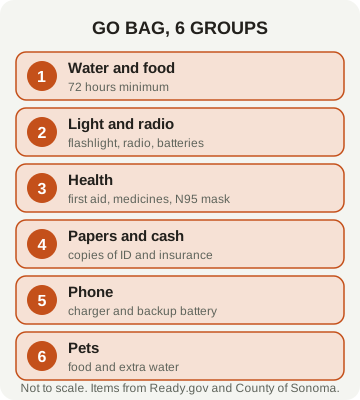
- Water and food, at least 72 hours.
- Flashlight, battery or hand crank radio, extra batteries.
- First aid kit, prescription medicines, N95 mask.
- Copies of ID, insurance policies and bank records, plus cash.
- Phone charger and a backup battery.
- Pet food and extra water.
| Group | What the sources list |
|---|---|
| Water and food | Emergency water and food for a minimum of 72 hours (County). Ready.gov's general kit uses one gallon of water per person per day. |
| Light and radio | Lights and blankets (County). Flashlight, battery-powered or hand crank radio, extra batteries, whistle (Ready.gov). |
| Health | First aid kit and an N95 mask for smoke (Ready.gov). A supply of prescription medicines (Ready.gov). |
| Papers and cash | Copies of insurance policies, ID and bank records, saved electronically or in a waterproof, portable container. Cash or traveler's checks (Ready.gov). |
| Phone | Cell phone with chargers and a backup battery (Ready.gov). |
| Pets | Pet food and extra water (Ready.gov). |
The County also asks for a separate home kit with at least 7 days of supplies. See our power outage checklist for that side.
Do this week
- Find your evacuation zone. Sonoma County lets you enter your address in a zone lookup tool and map. Zones now stay mostly the same from one incident to the next, but they can change slightly, so check yours again each year (County of Sonoma).
- Write your zone name in your plan and share it with family or friends who live out of town.
- Sign up for alerts. The County points to SoCoAlert and Nixle for life safety notifications. Our resources list has the links.
- Pack the bag from the table above. Keep it where you can reach it fast, or in the car as Ready.gov allows.
- Photograph your insurance policy and ID and save copies to a phone or waterproof container.
- Practice the route. Ready.gov says to learn your evacuation routes, practice with pets, and decide where you will go.
- Set a calendar reminder to refresh water, food, batteries and medicines every few months.
If an order is issued
Ready.gov says to evacuate immediately if authorities tell you to, and to check with local authorities about public shelters. It also suggests making plans to stay with friends or family. In an emergency call 9-1-1. For questions, call 2-1-1 (County of Sonoma).
Where this fits
A go bag protects your household. A hardened home protects what you leave behind, and insurers ask about it. See Zone 0 in Sonoma County and the Wildfire Prepared Home checklist. Back to Home Ready Sonoma.
Sources
- County of Sonoma: Build a Kit (72-hour go bag, 7-day home kit; read October 15, 2026)
- County of Sonoma: Know Your Zone (zone lookup, alerts, phone numbers; read October 15, 2026)
- Ready.gov: Build a Kit (item list; read October 15, 2026)
- Ready.gov: Wildfires (go bag, routes, N95, evacuating; read October 15, 2026)