Trees near power lines: who is responsible?
Who trims what on a Sonoma County property, the distances PG&E works to, and who to call before a winter storm.
Published November 4, 2026.
Storms put trees and wires in the same place. PG&E trims trees near its lines to keep power flowing. Winter wind warnings here start at 40 mph, or gusts of 58 mph [1].
So who deals with the tree? It depends on which wire it is near. PG&E trims around its own lines. The wire from the pole to your house is yours to keep clear [2].
Short answer
- Wires on poles in the street: PG&E inspects and trims. Do not touch them.
- The wire from the pole to your house (service drop): you keep it clear of plants and of dead or hazardous trees.
- Tree hazard right now: call 9-1-1 if it is an emergency. Otherwise call PG&E at 1-800-743-5000.
This page covers PG&E lines. If another utility serves your address, check its website for its rules.
Three kinds of wire
PG&E describes three kinds of wire you may see near trees [2]:
- Distribution lines. The neighborhood lines, usually at the top of a wood pole above the phone and cable lines. PG&E manages trees near these.
- Transmission lines. The big lines, often on tall metal towers. PG&E also manages trees near these, with larger clearances.
- Service drops. The wires from the pole to your home or business. Property owners are responsible for keeping these clear of plants and of dead or hazardous trees.
Phone and cable lines are maintained by those companies, not PG&E [2].
The distances to know
PG&E says it works year-round to keep these minimum clearances around neighborhood lines [2]:
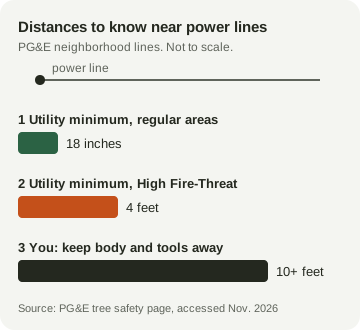
- 18 inches around wires in regular areas
- 4 feet in High Fire-Threat Districts, the areas the California Public Utilities Commission (CPUC) maps as higher fire risk
- 10 feet or more: where you keep your body and tools
For transmission lines the minimum ranges from 4 to 15 feet, depending on voltage [2].
To see if your address is in a High Fire-Threat District, use the CPUC map. Our fire hazard zone check shows the separate fire hazard zones.
What is yours to do
- Service drop. Look at the wire from the pole to your house. Keep plants off it. Deal with any dead or hazardous tree that could fall on it.
- Wood from trees PG&E cuts. Branches under 4 inches thick are chipped and hauled, or cut up and spread on site, if safe. Larger wood stays on your property and is yours to deal with [2].
- Planting. Plant trees a safe distance from overhead and underground lines. Call 811 at least two working days before you dig or plant [2].
What not to do
Touching a power line can cause serious injury or death. PG&E says only trained, line-clearance-qualified workers with the right tools should do tree work near power lines [2].
- Stay at least 10 feet from lines with your body and tools.
- Do not trim branches that touch or sit near neighborhood lines. Call PG&E instead.
- If you need to work near your service drop, you can ask PG&E for a free, temporary service disconnect [2].
We are not a licensed contractor and do not do tree work near power lines. If a tree needs to come down, hire a licensed, insured tree service.
Do this before the storms
- Walk your lot after dry weather. Look up at the wire from the pole to your house.
- Note any dead, leaning or cracked limbs near it. Take photos. While you are looking up, check branches over the roof and chimney too. Fire rules set limits for those, and our sister site explains how far tree branches must stay from your house.
- If you spot a hazard near PG&E's lines, report it. PG&E has a Report It program where you can send photos [2].
- Save PG&E's numbers in your phone: 1-800-743-5000 for tree hazards, 1-800-270-9750 for questions about wood from their tree work [2].
- Plan for an outage. See our power outage checklist.
After a storm
If a tree or limb is on a wire, stay back and call 9-1-1. Then call PG&E at 1-800-743-5000 [2].
After storms, PG&E emergency crews restore power. They may help clean up tree debris if it is needed to restore service. Phone and cable companies restore their own lines [2].
Who this applies to
Any Sonoma County home with trees near overhead lines or a service drop. If your lines run underground, the 811 call before digging matters most.
The rules above come from PG&E and state agencies and can change. Confirm with PG&E and your local fire authority.
Related
- Power outage checklist for Sonoma County
- El Niño 2026 and Sonoma County
- Clean gutters before the storms
- Home Ready Sonoma