Power outage preparedness checklist for Sonoma County
What to have ready before the lights go out, how long food lasts, and how to run a generator without hurting anyone.
Updated November 9, 2026. General information from Ready.gov, USDA, PG&E and Sonoma County. Not medical, legal or engineering advice.
The short answer
List the things in your house that need power, then plan a backup for each one. Ready.gov starts the same way [1].
Sonoma County says a home kit should hold at least 7 days of supplies, and a go bag at least 72 hours [2].
Plan for more than a few hours. In 2024 the average PG&E customer in its Sonoma division was without power about 13 hours over the year, across about 2 separate outages [3]. That is our calculation, explained below.
If your power is off now
- Open PG&E's outage map and click your area for its estimated restoration time.
- Keep the refrigerator and freezer shut. Use the food times in the table below.
- Charge phones and power banks whenever you have power. Keep your go bag where you can reach it.
- Generator only outdoors, at least 20 feet from windows, doors and the garage [1].
- On a well? Your pump stops with the power. Use stored water and see the well guide linked below.
How often the power goes out here
PG&E reports to the state every year how long its customers were without power, region by region. One region is its Sonoma division [3]. We turned its minutes into hours.
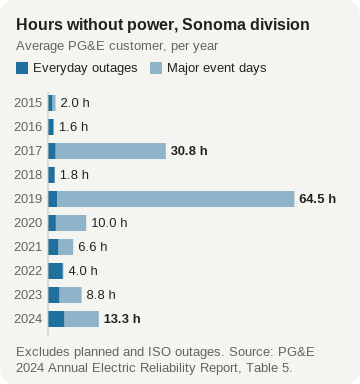
- Over 10 years the average was about 14 hours a year. Two years pull that up: 2019 at 64.5 hours and 2017 at 30.8 hours. In a typical year it was closer to 8.
- One quiet year says little about the next. 2018 had 1.8 hours. 2019 had 64.5.
- Everyday outage time is rising too. Leave out the major event days and the average customer lost 4.3 hours in 2024, about 3.6 times the 1.2 hours in 2015.
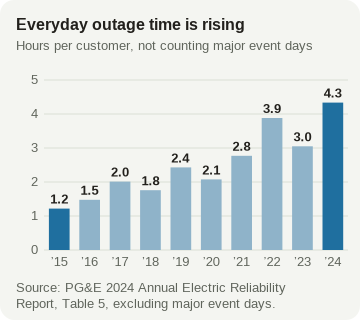
What these numbers are: averages across all customers in the division, not one home. Planned maintenance outages and grid operator (ISO) outages are left out. The report does not say whether planned power shutoffs (PSPS) are counted. The division's borders are PG&E's, not the county line, and customers of other utilities are not in it.
Before an outage: do this week
- Make a list of what needs power. Well pump, medical devices, phones, garage door opener, sump pump. Plan a backup for each [1].
- Get a flashlight for each person in the house, and a power bank for phones [1].
- Check whether your home phone works without power and how long its battery backup lasts [1].
- Install carbon monoxide detectors with battery backup on every level [1].
- Store food and water for 7 days. See the water table below [2][4].
- Ask your medical provider for a plan for powered devices and refrigerated medicine, including how long your medicine can tolerate heat [1].
- Check your PG&E contact preferences, so shutoff alerts reach you. PG&E aims to send them 48 hours, 24 hours and just before a shutoff [5].
- Find out where community locations with power are, and ask local officials about heating and cooling sites [1].
- Sign up for county alerts. See the resources list.
How much water to store
Ready.gov says at least 1 gallon per person per day, for drinking and cleaning up [4]. The county's home kit covers 7 days [2]. That works out to:
| People at home | Water for 7 days |
|---|---|
| 1 | 7 gallons |
| 2 | 14 gallons |
| 4 | 28 gallons |
| 6 | 42 gallons |
Our calculation from Ready.gov and County of Sonoma guidance. Method: people x 1 gallon x 7 days. A minimum: children, nursing mothers and sick people may need more, and hot weather can double what you need [4]. Replace water you bottled yourself every 6 months [4].
On a well? The pump needs power, so your tap stops in an outage. The Downspout, a Sonoma County water site, has a full guide: No power, no water: getting a well ready for an outage.
If someone at home relies on medical equipment
- PG&E's Medical Baseline program is for people who depend on power for certain medical needs, like oxygen or dialysis. It is based on medical need, not income [5].
- Enrolled customers get extra shutoff alerts, which may include several texts, phone calls or a doorbell ring [5].
- Your doctor has to confirm you qualify [5].
- Have a backup plan anyway: a battery for the device, a place with power you can go to, and someone who will check on you.
During an outage
- Keep the refrigerator and freezer closed.
- Never heat the house with a gas stove or oven. Ready.gov warns of carbon monoxide poisoning and fire.
- Unplug or switch off appliances and electronics so a surge does not hit them when power returns.
- Use coolers with ice if needed, and a thermometer to check temperatures.
- If it gets very hot or cold, go to a community location with power.
Source: Ready.gov [1].
How long food lasts
| Item | With the doors shut |
|---|---|
| Refrigerator | Keeps food cold about 4 hours |
| Half-full freezer | Holds its temperature about 24 hours |
| Full freezer | Holds its temperature about 48 hours |
| Throw out | Food at 40°F or higher for 2 hours or more, or with an odd smell, color or texture |
Fridge, full freezer and the throw-out rule: Ready.gov [1]. Half-full freezer: USDA [7].
After an outage of more than a day, throw out medicine that should be kept cold unless the label says otherwise, and call your doctor or pharmacist for a new supply. Ready.gov's rule: when in doubt, throw it out [1].
Running a generator safely
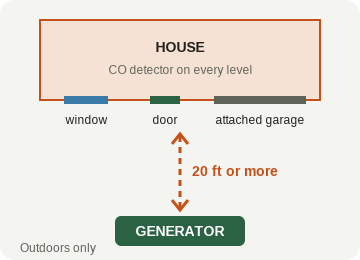
- Run it only outdoors, at least 20 feet from windows, doors and attached garages. Keep the fuel there too.
- Keep it dry and out of rain and standing water. Do not touch a wet generator.
- Use heavy-duty extension cords to connect appliances.
- Let it cool before you refuel.
- Camp stoves and charcoal grills also belong outdoors, 20 feet from windows.
- Follow the maker's instructions.
Source: Ready.gov [1]. Connecting a generator to your house wiring is electrician work, which we do not do. Hire a licensed electrician directly.
Still choosing one? Our backup power guide compares power stations and generators and sizes one for your house. PG&E may pay up to $300 toward a small one: see which models qualify.
Where this fits with storm prep

Outages often come with the same storms that fill gutters and flood low spots. Pair this list with our winter storm checklist, the sandbag guide and the El Niño guide.
Sources
- Ready.gov: Power Outages (before, during and after steps, food times, generator safety; read October 14, 2026)
- County of Sonoma: Build a Kit (7-day home kit, 72-hour go bag; read October 17, 2026)
- PG&E: 2024 Annual Electric Reliability Report, Table 5, Division Reliability Indices, Sonoma division (read October 17, 2026)
- Ready.gov: Water (1 gallon per person per day, replace every 6 months; read October 17, 2026)
- PG&E: Medical Baseline program (who qualifies, extra alerts, shutoff alert timing; read October 17, 2026)
- County of Sonoma: Public Safety Power Shutoff notice (October 14, 2026 shutoff; read October 17, 2026)
- USDA Food Safety and Inspection Service: Keep Your Food Safe During Emergencies (half-full freezer about 24 hours; read November 9, 2026)