Water heater strapping requirements in Sonoma County
What California law and Permit Sonoma require, how to check your own water heater in 10 minutes, and what sellers must certify.
The short answer
Water heater strapping requirements in California start with one state law. Every new, replacement and existing home water heater must be braced, anchored or strapped so it can't fall over or slide in an earthquake [1].
In unincorporated Sonoma County, Permit Sonoma spells out what that means for a tank water heater [2]:
- Two straps, one in the upper third of the tank and one in the lower third.
- Each strap wraps all the way around the tank and goes back to the wall.
- The lower strap sits at least 4 inches above the controls.
- A third strap for a heater over 52 gallons.
- Strap ends go into a stud with a lag bolt of at least 1/4 inch by 3 inches, with a washer.
- No plumber's tape. Permit Sonoma does not accept it as strapping.
Why it matters in an earthquake
A full tank is heavy, and many are connected to a gas line. The California Governor's Office of Emergency Services says a strapped water heater with a flexible gas supply line lowers the risk of a fire or explosion from a gas leak after an earthquake [3].
The same sheet says that if your water heater does not have a flexible gas supply line, you should have a licensed plumber install one [3].
For the rest of the house, see our earthquake preparedness checklist.
A strapped tank is also your backup water supply. Our sister site The Downspout shows how to drain a water heater for water in an emergency. And for a house built before 1980 that has been bolted and braced, a secured water heater is one of the conditions for the California Earthquake Authority's retrofit discount on earthquake insurance [5]. Home Ready California explains whether earthquake insurance is worth it.
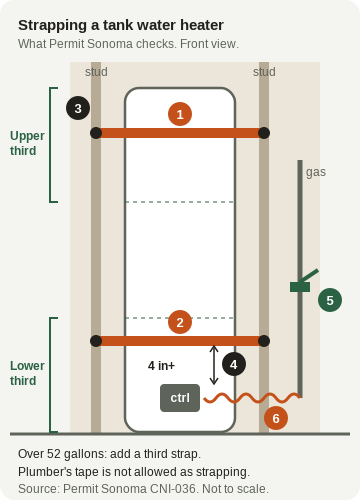
- A strap within the upper third of the tank, wrapped all the way around and back to the wall [2].
- A strap within the lower third [2].
- Each strap end into a stud with a lag bolt of at least 1/4 inch by 3 inches, with a washer [2].
- The lower strap at least 4 inches above the controls [2].
- A gas shut-off valve next to the heater, ahead of the flex connector [2].
- A flex connector for the final gas connection, 3 feet long at most [2].
Plumber's tape: why older guides show it
Plumber's tape is thin, perforated steel strap with rows of small holes. An older state how-to sheet, credited to the Division of the State Architect, shows a method that wraps the tank with 24 gauge plumber's tape and braces it with metal conduit [3].
Permit Sonoma's current handout says plumbing tape is not permitted as strapping material [2]. If you follow an old guide or video, check it against Permit Sonoma's list first.
Rules differ by city too. Los Angeles, for example, does not accept plumber's tape on water heaters over 40 gallons [4]. State law allows local changes to the plumbing code [1], so ask your own building department.
Check yours this week
You don't need tools for this. Look, measure and write down what you find.
- Count the straps. Two, one in the upper third and one in the lower third [2].
- Read the label for the size. Over 52 gallons needs a third strap [2].
- Measure from the controls to the lower strap. It should be at least 4 inches [2].
- Look at the strap itself. A thin strip with rows of small holes is plumber's tape, which Permit Sonoma does not accept [2][3].
- Look where the straps meet the wall. They should end at a stud with a lag bolt and washer [2].
- Follow the gas line. Look for a shut-off valve next to the heater and a flexible connector, 3 feet or shorter [2]. A rigid pipe all the way in is a job for a licensed plumber [3].
- In a garage, check the height. A gas water heater's burner should be at least 18 inches above the floor, unless the heater is listed as flammable vapor ignition resistant [2].
- Find the end of the relief valve line. It should run outside and end 6 to 24 inches above the ground, pointing down [2].
Our tip: take a photo of the whole heater and the label. If you call a plumber or Permit Sonoma, it answers most of their first questions.
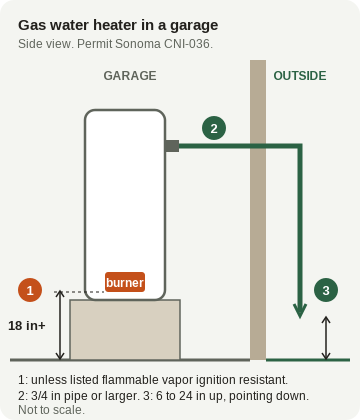
- In a garage, burners and burner ignition at least 18 inches above the floor, unless the heater is listed as flammable vapor ignition resistant [2].
- The temperature and pressure relief valve drain line runs to the outside. It is at least the valve's outlet size, and never smaller than 3/4 inch copper or galvanized pipe [2].
- The end points down, no more than 24 inches and no less than 6 inches above the ground [2].
Replacing a water heater in Sonoma County
Permit Sonoma offers auto-issued permits for replacing a water heater, and plans are not required [2]. Its handout lists what the inspector looks for, including:
- The strapping above, or the maker's instructions for a tankless heater [2].
- An expansion tank or other approved device to control pressure from heated water [2].
- Insulation on the first 8 feet of hot and cold pipe [2].
- For gas heaters, vent clearances and the gas line size. The inspector may ask for the maker's specs and a pipe drawing, and a new gas line needs a pressure test [2].
Inside city limits, your city's building department handles the permit instead. Ask them for their water heater checklist.
Selling or renting out a home
If you sell a home with a water heater, state law says you must certify to the buyer, in writing, that it is braced, anchored or strapped [1].
That can go in papers you already use, such as the transfer disclosure statement or the state's Homeowner's Guide to Earthquake Safety [1].
A landlord may not evict a tenant in order to strap a water heater [1]. A home that breaks the strapping rule can be treated as a nuisance [1].
Who this applies to
- Every home with a standard water heater of 120 gallons or less that a ready-made strapping kit fits. That is how the law defines a water heater [1].
- Old heaters too, not only new ones. The law covers existing home water heaters [1].
- Anyone selling a home [1].
- Tankless heaters follow the maker's bracing instructions [2].
- Anyone replacing a water heater in unincorporated Sonoma County. Permit Sonoma's handout applies [2].
Related
- Earthquake preparedness checklist
- Earthquake retrofit: brace and bolt
- Carbon monoxide during a power outage
- How to protect pipes from freezing
- Home Ready Sonoma home
Sources
- California Health and Safety Code section 19211 (all new, replacement and existing home water heaters braced, anchored or strapped; local modifications; seller's written certification; no evictions; 120 gallon definition; nuisance; read November 20, 2026)
- Permit Sonoma: CNI-036 Water Heaters (strap number and position, 4 inches above controls, third strap over 52 gallons, lag bolts, no plumbing tape, gas valve and flex connector, garage 18 inches, relief valve line, expansion tank, auto-issued permits; version August 30, 2023; read November 20, 2026)
- California Governor's Office of Emergency Services: How to Strap Your Water Heater (PDF copy hosted by CERT-LA, credited to the Division of the State Architect; flexible gas line, conduit and plumber's tape method; read November 20, 2026)
- City of Los Angeles Building and Safety: How to Brace Your Water Heater (P/PC 2026-003, revised March 16, 2026; example of a city rule; read November 20, 2026)
- California Earthquake Authority: Earthquake Insurance Policy Premium Discounts (retrofit discount conditions, water heater secured to the building frame; read November 28, 2026)