Carbon monoxide during a power outage
Why the risk goes up when the power goes out in Sonoma County, where CO alarms go, and what to do if one sounds.
The short answer
Carbon monoxide during a power outage usually comes from what people use to replace the power: a generator, a grill, a camp stove, or a car in the garage.
Carbon monoxide (CO) is a gas with no color and no smell. It comes from burning fuel, and it can build up indoors [1].
Three rules cover most of the risk:
Why the risk goes up when the power is out
More than 200 people in the United States die each year from accidental carbon monoxide poisoning not linked to fires. More than 100 of those deaths are linked to portable generators [2].
In Sonoma County, storms and high winds can knock out power. The County notes that the energy provider, not the County, decides when power comes back [4]. So an outage can last long enough that people reach for a generator or a grill.
A generator in the wrong spot is the big one. The County says never to run a portable generator in a garage, carport, basement, crawl space, or any enclosed or partly enclosed area. Opening doors and windows or using fans will not stop CO from building up [3].
Even 20 feet away, the wind can still push CO into a house through attic vents, windows or doors. That is why the County says a working CO detector inside matters [3].
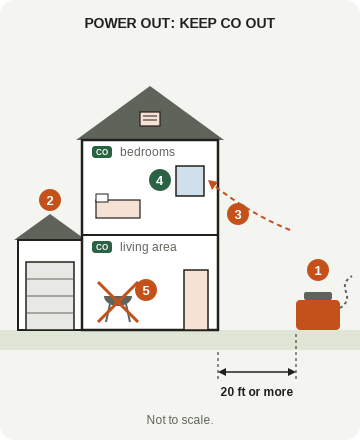
- Run a generator outside only, at least 20 feet from the house, with the exhaust pointed away [2][3].
- Never run a generator in the garage, even with the door open [1]. Never run a car or truck in an attached garage, even with the door open [1].
- CO can still blow in through attic vents, windows or doors from 20 feet away [3].
- Put CO alarms on every level of the home and outside sleeping areas. Use battery-operated alarms or ones with battery backup [2].
- Never burn charcoal indoors, and don't use a portable gas camp stove inside [1].
Do CO alarms work when the power is out?
Only if they have a battery. The CDC, the Consumer Product Safety Commission and the County all say to use CO alarms that run on batteries or have battery backup [1][2][3].
Our tip: check yours before the next storm. If an alarm plugs into the wall or is wired into the ceiling, look for a battery door. If there is none, it may go quiet when the power does.
- Where: on every level of the home and outside sleeping areas [2]. The CDC says near every sleeping area [1].
- Linked alarms are best: when one sounds, they all sound [2].
- Batteries: the CDC says to check them when you change your clocks in spring and fall [1].
- Age: replace the alarm when the maker says to, or every 5 years [1].
Our tip: if an alarm chirps after an outage, read the label on the back or the manual. Chirp patterns mean different things on different brands. A full alarm is never something to wait out.
If the alarm sounds or someone feels sick
If you suspect CO poisoning, get outside to fresh air right away, then call 9-1-1 [2]. If you feel sick, dizzy or weak while a generator is running, the County says to get to fresh air right away [3].
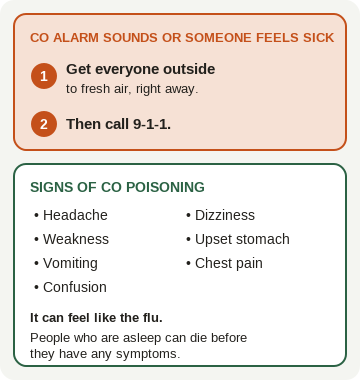
The most common signs are headache, dizziness, weakness, upset stomach, vomiting, chest pain and confusion. People often describe them as flu-like [1].
People who are asleep or have been drinking can die from CO before they have symptoms [1]. That is why the alarm matters more than how you feel.
Running a generator safely
The County's generator safety page adds a few rules beyond CO [3]:
- Keep it dry. Don't run it in rain or wet conditions. Run it on a dry surface under an open, canopy-like cover.
- Let it cool before you refuel. Gas spilled on a hot engine can catch fire.
- Store fuel in an approved safety can, outside living areas.
- Never plug a generator into a wall outlet. This is called back feeding. The only safe way to connect one to house wiring is through a transfer switch installed by a qualified electrician.
- Plug appliances straight into the generator, or use a heavy-duty, outdoor-rated extension cord.
Not sure a generator is the right fit? Our power station or generator guide compares the two.
Steps you can do this week
- Count your CO alarms. One on every level and outside sleeping areas [2].
- Check that each one has a battery and test it [3].
- Look for the date on the back. Replace it if the maker's date has passed, or after 5 years [1].
- Pick your generator spot now, outside, dry, at least 20 feet from the house, exhaust pointed away from windows, doors and vents [2][3]. Measure it in daylight so you are not guessing in the dark.
- Buy a heavy-duty outdoor extension cord long enough to reach from that spot [3].
- Plan heat and cooking without fuel indoors. No charcoal or camp stove inside [1]. Our guide to keeping warm in an outage covers one warm room and safe heat.
- Tell everyone in the house what the CO alarm sounds like, and that it means go outside first.
Who this applies to
- Every home. The CDC says everyone is at risk [1].
- Homes with babies, older adults, or anyone with heart disease, anemia or breathing problems. They are more likely to get seriously ill [1].
- Anyone who owns or plans to borrow a portable generator.
- Homes with an attached garage.
For the rest of your outage plan, see the power outage checklist.
Related
- Keep your house warm in a power outage
- Power station or generator?
- Power outage checklist
- What to do if you see a downed power line
- Home Ready Sonoma home
Sources
- CDC: About carbon monoxide poisoning (what CO is, symptoms, who is most at risk, detectors, generators, cars in garages, charcoal and camp stoves; reviewed October 26, 2026; read November 19, 2026)
- U.S. Consumer Product Safety Commission: Carbon Monoxide Information Center (alarm placement, linked alarms, what to do if you suspect CO, generators 20 feet away, deaths each year; read November 19, 2026)
- County of Sonoma: Generator safety (enclosed spaces, fans and windows, 20 feet, CO alarms, dry operation, fuel, back feeding; read November 19, 2026)
- County of Sonoma: El Niño and Winter Storms (power outages and who restores power; checked November 18, 2026)