How long does food last in the fridge without power?
What to keep, what to toss, and how to keep the fridge cold through a PG&E shutoff or a winter storm.
We may earn a commission when you buy through some links on this page. It never decides which models we pick.
Food in a closed fridge stays safe for about 4 hours without power [2][3]. October's shutoff ran far longer than that here.
PG&E started shutting off power on the evening of October 14, ahead of dry, gusty winds. In Sonoma County, 2,041 customers went dark [1].
Crews didn't start checking lines here until midday on October 16. Checking comes before the power goes back on [1]. So nearly all of those fridges sat dark for more than a day. That's our count from PG&E's updates.
Here's how to tell what's still safe, what to toss, and how to keep a fridge cold next time.
- Fridge: about 4 hours, if the door stays shut [2][3].
- Freezer: about 48 hours if it's full, about 24 if it's half full [2][3].
- Fridge off more than 4 hours: toss meat, fish, eggs, milk, soft cheese and leftovers [2]. Same for any of those that sat at 40°F or warmer for more than 2 hours [4].
- Never taste food to test it. When in doubt, throw it out [2][3].
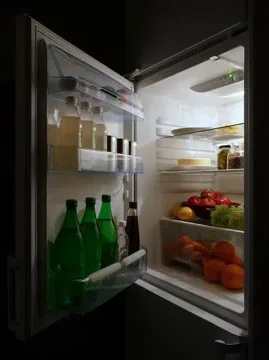
Is my food still safe?
- Pick the fridge or the freezer.
- Pick how long the power has been out.
- If there's a thermometer inside, read it. For the freezer, you can also feel the food for ice crystals.
Based on USDA, CDC and FoodSafety.gov guidance [2][3][4]. Anything with an odd smell, color or texture goes, whatever the answer says [2].
Keep or toss: the usual suspects
Look for your food in the left column first. This is for a fridge that's been off more than 4 hours, or food that sat above 40°F for more than 2 hours [4].
| Toss | Usually fine |
|---|---|
| Raw or cooked meat, poultry and fish. Lunchmeat, hot dogs, bacon | Hard cheese: cheddar, Swiss, Parmesan |
| Milk, cream, yogurt, sour cream | Butter and margarine |
| Soft and shredded cheese: brie, mozzarella, cottage, jack | Whole fresh fruit and vegetables |
| Eggs and egg dishes | Bread, tortillas, muffins, bagels |
| Leftovers, pizza, cooked pasta, rice and potatoes | Ketchup, mustard, jam, pickles, soy sauce, peanut butter |
| Cut fruit, cut vegetables, bagged salad greens | Vinegar dressings and opened fruit juice |
| Opened creamy dressing, spaghetti sauce, baby formula | Fruit pies |
Opened mayonnaise, tartar sauce and horseradish get longer. Toss them only if they sat above 50°F for more than 8 hours [4].
The full list, with frozen foods too, is on FoodSafety.gov.
An $8 thermometer settles it
The 4 hours is a guess for when you can't check. A thermometer in the fridge and one in the freezer tell you for sure [2][5].
Why two numbers? The 4 hours is how long a shut fridge stays cold. The 2 hours is how long food can sit once it's warmer than 40°F. The thermometer tells you which clock you're on.
Fridge should read 40°F or below. Freezer, 0°F or below [2]. When the power comes back, read them before you open anything else.
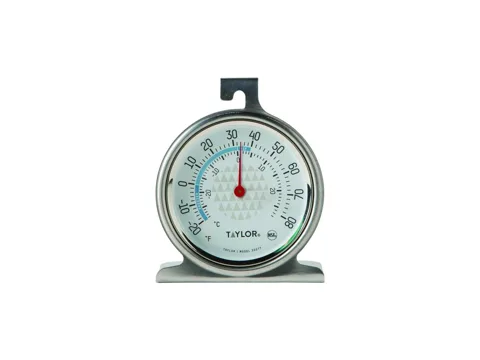
Our pickTaylor Refrigerator/
Freezer Dial Thermometer Reads -20°F to 80°F · hangs or stands · no batteries · $7.99
The cheapest fix on this page. Buy two, one for each box. No batteries to die in the middle of an outage.
Keep it cold with what you have
For an outage of a few hours, you need no gear at all. Keep the doors shut. These help on longer ones:
- Freeze water jugs now. Fill the gaps in the freezer with them. A full freezer stays cold longer [2]. Melted, they're drinking water too [5].
- Freeze what you won't need right away before a shutoff: leftovers, milk, fresh meat [2].
- Keep food bunched together. It stays cold longer [2].
- Past 4 hours, use a cooler. Pack perishables with ice or frozen gel packs. Keep it at 40°F or below and add ice as it melts [2].
- Long outage? Get block or dry ice. About 50 pounds of dry ice holds an 18 cubic foot freezer for 2 days. Don't touch it bare-handed, and don't let it touch food [2].
Why outages here outlast the fridge
Sonoma County gets two kinds of long outage. Each calls for a different fix.
- Shutoffs come with a warning. A Public Safety Power Shutoff (PSPS) is when PG&E turns power off ahead of fire weather. In October, its first notices went out about two days ahead [1]. That's time to freeze jugs and set out the cooler.
- Storm outages don't. Three days after a February 2024 storm, about 15,800 North Bay PG&E customers were without power [6]. A storm can knock it out at 2 a.m., or while you're at work.
Prep covers the first kind. The second is where gear that switches on by itself earns its keep. See how often the power goes out here in our power outage checklist.
Gear that keeps the fridge running
Do you need any? If your outages are short and you're usually home, probably not. Gear makes sense when outages run past a day, or happen while you're away.
The runtimes below are our estimates. By our math, a typical fridge uses about 1.5 kWh a day [7][8].
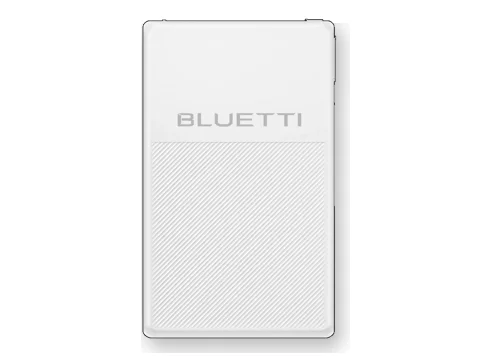
Our pickBluetti FridgePower
2,016 Wh · 1,800 W · adds batteries up to 8,064 Wh · $949
Best for a fridge that keeps running when no one is home. It sits beside the fridge, plugged into the wall, and takes over in under 10 milliseconds when the power drops. Its app tells your phone the power went out [9].
A little over a day for a typical fridge, by our math. About 14 hours if it runs a freezer too.
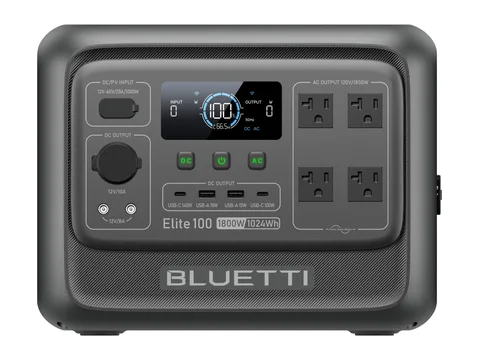
Budget pickBluetti Elite 100 V2
1,024 Wh · 1,800 W · 25 lb · $499
Gets a fridge through one night: about 14 hours, by our math. It also switches over in 10 milliseconds if you leave the fridge plugged into it [10]. In stock at Bluetti on November 13.
Want to add batteries to a 1 kWh station later? We like the EcoFlow DELTA 3 Plus for that. It's in our backup power guide. Both stations above hold more than 1,000 Wh, so neither qualifies for PG&E's battery rebate [12].
How we did the math: a fridge draws about 192 W while it runs and runs about a third of the time [7][8]. That's about 1.5 kWh a day. A freezer uses about the same [8]. A battery delivers about 85% of its rated size [11]. So 1,024 Wh gives about 870 Wh, or 14 hours. Your fridge's label beats our number.
Out for days? A generator
A gas generator runs a fridge and a freezer for as long as it has fuel. Run it outdoors only, at least 20 feet from the house [13]. Our backup power guide sizes one and lists models you can buy in California.
What it means for you
- This week: put a thermometer in the fridge and one in the freezer.
- When the next shutoff notice comes: freeze jugs and anything you won't need right away.
- Out past a day, or often away? A battery that switches on by itself keeps the fridge from going dark at all.
The next shutoff notice may come two days ahead, like October's did. That's two days to get the fridge ready.
Related
- Power outage preparedness checklist for Sonoma County
- Power station or generator? Backup power for Sonoma County outages
- Winter storm checklist for Sonoma County homes
- Outside Sonoma County? Our statewide guide covers heat waves and other utilities: power outage food safety in California.
Sources
- PG&E, Public Safety Power Shutoff updates, October 13 to 17, 2026
- USDA Food Safety and Inspection Service, Keep Your Food Safe During Emergencies
- CDC, Keep Food Safe After a Disaster or Emergency, reviewed November 24, 2025
- FoodSafety.gov, Food Safety During Power Outage (keep or toss charts), reviewed August 8, 2024
- U.S. Food and Drug Administration, Food and Water Safety During Power Outages and Floods
- CBS News Bay Area, outages three days after the storm, February 7, 2024
- U.S. Department of Energy, Estimating Appliance and Home Electronic Energy Use
- Honda Power Equipment, Generator Wattage Calculator
- Bluetti, FridgePower product page, checked November 13, 2026
- Bluetti, Elite 100 V2 product page, checked November 13, 2026
- Jackery, What Is a Watt-hour
- PG&E, Generator and Battery Rebate Program, checked November 13, 2026
- U.S. Consumer Product Safety Commission, winter weather safety tips, January 3, 2025
Food safety guidance from USDA, CDC, FDA and FoodSafety.gov, checked November 7, 2026. Prices and stock from each maker's own site, checked November 13, 2026. Sale prices change often.