How to prepare your house for high winds
A short checklist for Sonoma County homes, plus what a Wind Advisory, Watch and Warning ask you to do.
The short answer
To prepare your house for high winds, the National Weather Service says to trim branches away from the house and power lines, secure loose gutters and shutters, and tie down or put away anything outside that could blow away or go through a window [1].
Charge phones and batteries, keep 3 days of food and water for each person, and pick an inside room to wait it out [1].
Do the trimming and gutter work on a calm day. When a High Wind Watch goes out, secure the loose items right away, before the wind picks up [1].
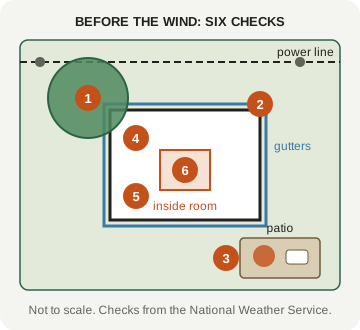
- Branches over the roof or near the power line
- Loose gutters and shutters
- Umbrellas, cushions, bins and other loose items
- Phones, radios and tool batteries charged
- 3 days of food and water per person
- An inside room to shelter in
Why now
As of November 11, 2026, the Weather Service's Bay Area office expected moderate rain on Friday, with gusts up to 30 mph, and another round of rain Sunday into early next week [4].
That is not a High Wind Warning. It is a good time to do the checks below, before Friday, while it is still calm.
Sonoma County notes that high winds can come at any time of year, and that wind can shift fast and without warning [2].
Wind Advisory, Watch or Warning: what each means
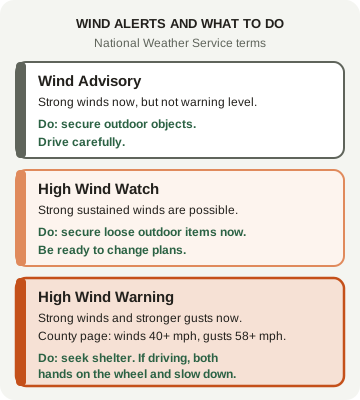
The Weather Service uses three main wind alerts on land [5]:
- Wind Advisory: strong winds are happening, but not strong enough for a warning. Secure outdoor objects and drive carefully.
- High Wind Watch: strong, sustained winds are possible. Secure loose outdoor items and be ready to change plans.
- High Wind Warning: strong, sustained winds with even stronger gusts are happening. Seek shelter. If you are driving, keep both hands on the wheel and slow down.
Each Weather Service office sets its own wind speeds for these alerts [5]. Sonoma County's page says a High Wind Warning is issued when winds are expected to be 40 mph or more, and gusts 58 mph or more [2].
Who this applies to
- Every home. The county says high winds can happen any time of year [2].
- Homes with big trees over the roof, the driveway or the power line. Our guide to trees near power lines covers who trims what.
- Mobile and manufactured homes. The Weather Service says to pick a sturdy building to go to if a high wind or severe thunderstorm warning is issued [1].
- Anyone who drives the county's tree-lined roads in a storm. The county lists closed roads from fallen trees and power lines as one of the risks [2].

What to do this week
- Look up at your trees. Note branches over the roof, the driveway and the power line. The Weather Service says to trim branches away from the house and power lines [1]. Near a power line, PG&E says keep people and tools at least 10 feet away and report the hazard [3]. Our trees near power lines guide covers who to call.
- Check the gutters and shutters. Secure anything loose [1]. While you are up there, clear the leaves. Our gutter guide shows how.
- Make a list of loose outdoor items. Patio umbrellas, cushions, chairs, trash bins, trampolines, kids' toys. The Weather Service says to list what needs to be tied down or put away, so you can do it fast when a watch goes out [1].
- Charge batteries. Phones, a weather radio, and power tool batteries. The Weather Service names a reciprocating saw as a tool you might need to clear debris [1]. Our power outage checklist has the rest.
- Stock 3 days of food and water for each person in the house [1]. Our water site, The Downspout, explains how to store drinking water so it stays safe.
- Pick an inside room. An interior bathroom or a basement works [1]. Our tip: choose one with no big windows.
- Sign up for SoCoAlert. The county sends life safety alerts through SoCoAlert and Nixle [2].
When the wind arrives
- Under a watch, finish securing outdoor items before the wind picks up [1].
- Under a warning, go to your inside room [1].
- If you must drive, keep both hands on the wheel and slow down [5].
- If a tree is on a power line, stay at least 10 feet away [3] and call 9-1-1 if anyone is in danger.
- If the power goes out, the county says outage timing is up to the power company [2]. Check your utility's outage map and keep your phone charged.
Where to check during a storm
- National Weather Service Bay Area: current watches, warnings and advisories [4].
- County El Niño and winter storms page: wind, power outage and road information [2].
- County evacuation and storm conditions map: evacuations, stream gauges and road closures [2].
- Questions that are not emergencies: call 2-1-1 or text your ZIP code to 898-211 [2].
Related
- Power outage checklist
- Trees near power lines
- Gutters and roof debris
- Landslide warning signs
- Winter storm checklist
- Home Ready Sonoma
Sources
- National Weather Service: Before High Winds (trimming, gutters and shutters, loose items, batteries, 3 days of food and water, inside room, mobile homes; checked November 12, 2026)
- County of Sonoma: El Niño and Winter Storms (high wind section and warning speeds, power outages, SoCoAlert, storm map, 2-1-1; snapshot November 11, 2026)
- PG&E: Vegetation management (keep people and tools 10 feet from power lines, reporting tree hazards; snapshot November 11, 2026)
- National Weather Service, San Francisco Bay Area office (forecast story for Friday, November 13 and the following days; snapshot November 11, 2026)
- National Weather Service: Wind watch, warning and advisory definitions (checked November 12, 2026)