Landslide warning signs for Sonoma County homes
What to watch for around your house this winter, and what to do before, during and after a slide.
The short answer
Sonoma County lists these landslide warning signs: a tree that keeps leaning more, new cracks in walls, the foundation or the ground, doors or windows that suddenly stick, steps or walks pulling away from the house, tilting fences or retaining walls, ground bulging at the bottom of a slope, and water coming out of the ground in a new place [1].
Heavy rain on soaked hillsides raises the risk, most of all in recent burn scars and on steep ground [2].
Many of them you can spot on a walk around the lot. The list and steps below are from the county's guidance.
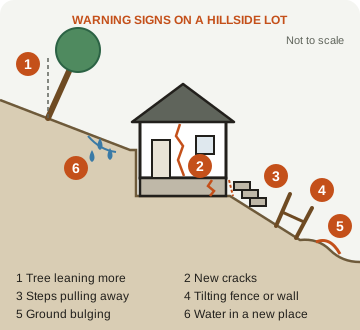
- A tree that keeps leaning more
- New cracks in walls, the foundation or the ground
- Steps or walks pulling away from the house
- A tilting fence, retaining wall or pole
- Ground bulging at the base of the slope
- Water coming out of the ground in a new place
Why this winter
The county Board of Supervisors has proclaimed an emergency to get ready for what may be a historic El Niño winter, with heavy rain, multiple storms and serious flooding risk [2].
The county's winter storms page names landslides as one of the risks. Wildfires add to it, because landslides and debris flows can rush down fire-scarred hillsides in the rainy season [2]. Our El Niño guide covers what El Niño does and does not mean for Sonoma County.
Who should pay attention
- Homes on or near steep slopes, mountain edges, drainage ways or natural erosion valleys [1].
- Homes below a recent burn scar [2]. Home Ready California, our statewide site, explains how little rain it takes to start a debris flow below a burn, and when to leave.
- Anyone in an area that has had debris flows before. The county says past slide areas are likely to slide again [1].
Not sure about your area? The county suggests finding out whether debris flows have happened there before [1].
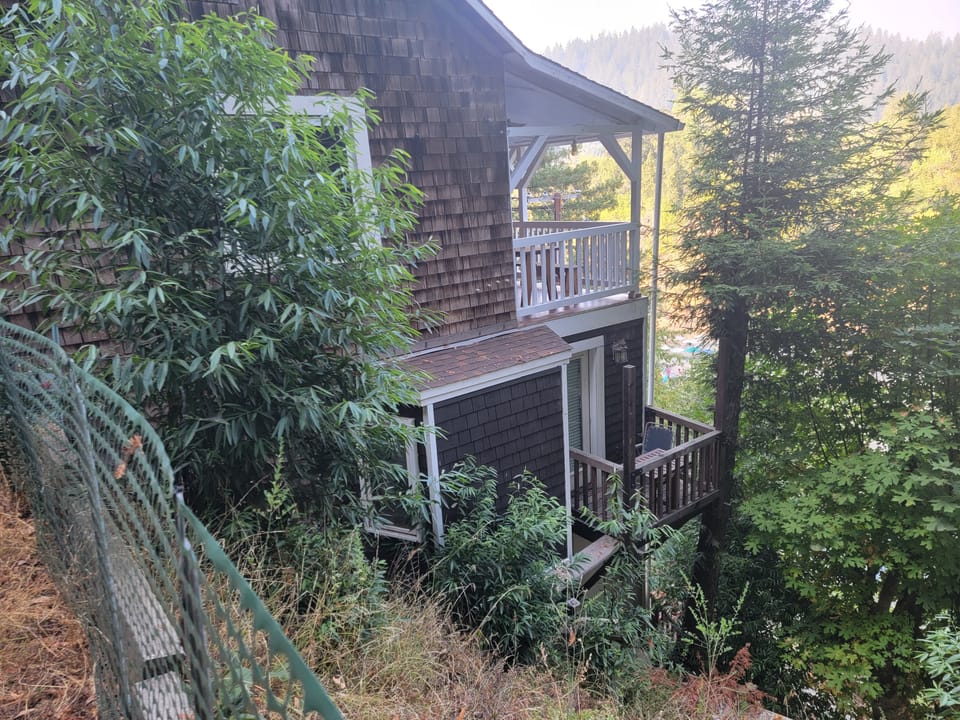
All the warning signs, in one list
From the county's page [1]. Check the outside of the house, then the inside.
- Outside: new cracks in the ground. Small slides. Fences, walls, poles or trees that tilt. Ground that bulges at the bottom of a slope.
- Water: storm water draining a new way, or water coming up where it never did.
- The house: doors or windows that suddenly stick. New cracks in walls or the foundation. Walls, walks or stairs pulling away from the building.
- Underground: utility lines that break.
- Sounds: a faint rumble that gets louder, or the sound of trees cracking and boulders knocking together.
What to do this week
- Take photos now. Shoot every crack, sticking door and leaning fence today, with a coin or tape measure in the frame. Then you can tell if it grows. Our tip.
- Walk the lot in the next rain. Watch where storm water runs and where it pools. A new path is one of the signs above [1]. Our tip: clear gutters and downspouts first, so an overflowing gutter does not fool you. Our gutter guide shows how.
- Look up your evacuation zone. The county's winter storms page has a zone lookup tool, and its evacuation and storm conditions map shows evacuations, stream gauges and road closures [2].
- Sign up for SoCoAlert. The county sends life safety alerts through SoCoAlert and Nixle [2].
- Keep phones charged. The county says to stay alert in heavy storms, keep devices charged, and follow local news or NOAA Weather Radio [1]. See our power outage checklist.
- Ask your insurance agent. The county suggests it. Its page says debris flow may be covered under National Flood Insurance Program policies [1]. Ask what your own policy covers, and make a home inventory while you are at it.
- Have a bag ready. If you have to leave fast, our go-bag checklist works for storms too.
Longer-term fixes for a slope
The county lists these [1]:
- Plant ground cover on slopes. Our water site shows how to cover bare soil and plant a slope before the rains.
- Build retaining walls.
- In areas where mud flows, build channels or deflection walls to steer it.
- Get a ground assessment of your property and ask a professional about what would help.
One catch from the county: if you steer a debris flow onto a neighbor's property, you could be liable [1]. Check with Permit Sonoma about permits before you build a wall or channel.
If a slide starts
- Move away from the path of the slide as fast as you can. Mud flows can move faster than a person on foot [1].
- Stay out of river valleys and low ground [1].
- Near a creek, watch for water that suddenly changes how it flows, or turns muddy. That can mean a debris flow upstream [1].
- If you cannot get away, curl into a tight ball and protect your head [1].
- Call 9-1-1, or Sheriff Dispatch at (707) 565-2121 [2].
After a slide
- If you are told to leave, or the house feels unsafe, go to a friend's or family member's home or a shelter [1].
- Stay away from the slide area. More slides can follow, and so can flooding [1].
- Do not go into the slide to help. Point rescuers to anyone hurt or trapped [1].
- Report broken utility lines and damaged roads [1].
- Check the foundation, the chimney and the land around the house for damage [1].
- Replant bare ground soon, to cut erosion and the chance of another slide [1].
- For questions that are not emergencies, call 2-1-1 or text your ZIP code to 898-211 [2].
Where to check during a storm
- County evacuation and storm conditions map: evacuations, stream gauges, road closures [2].
- National Weather Service Bay Area: watches and warnings for Sonoma County [3].
- County El Niño and winter storms page: sandbags, warming centers, road closures and more [2]. Our sandbag guide lists the sites.
Related
- El Niño 2026 and Sonoma County
- Sonoma County sandbags
- Gutters and roof debris
- Winter storm checklist
- Home Ready Sonoma
Sources
- County of Sonoma Department of Emergency Management: Preparing for Landslides (warning signs, before, during and after; checked November 11, 2026)
- County of Sonoma: El Niño and Winter Storms (emergency proclamation, landslide and burn scar risk, evacuation map, SoCoAlert, phone numbers; snapshot November 10, 2026)
- National Weather Service, San Francisco Bay Area office (watches, warnings and advisories; checked November 10, 2026)