Roof leaking during a storm? What to do first
What to do if your roof leaks during a storm: stay safe, catch the water, take photos, cover the damage, and call your insurer. Permanent repairs come later.
The short answer
- Stay safe. Don't go on the roof in rain or wind. Stay out from under a wet, sagging ceiling.
- Catch the water and move your things. Buckets, towels, and furniture out of the drip.
- Take photos before you clean up [1].
- Cover the damage to stop more water, and save the receipts [1][2].
- Report the water damage to your insurer right away if it may be over your deductible [1][2].
- Wait on permanent repairs until the adjuster has seen the damage, then hire a licensed contractor [1][3].
Right now, inside the house
These are our tips for the first hour. They are common sense, not rules.
- Stay off the roof. A wet roof in wind is no place to be. Wait for dry, calm weather, or have a roofer do it.
- Stay out from under a sagging or bulging ceiling. Keep kids and pets out of that room.
- Keep clear of a wet light fixture or outlet. If water is coming through a fixture, leave it alone and call a licensed electrician.
- Put a bucket under each drip, with a towel in the bottom to cut the splash. Lay towels or a tarp around it.
- Move furniture, rugs, boxes and electronics out of the wet area.
- Keep a flashlight close. PG&E says to keep a battery flashlight and radio within easy reach in a storm, and to use LED candles, not wax [4].
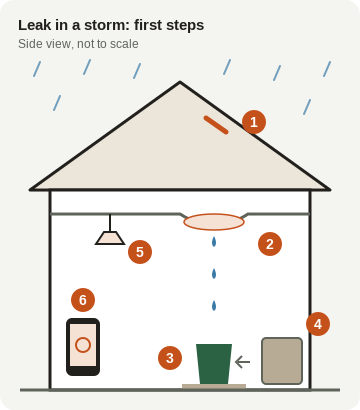
- Stay off the roof until it is dry and calm.
- Stay out from under a wet or sagging ceiling.
- Bucket and towels under the drip.
- Move furniture and boxes out of the way.
- Keep clear of a wet light fixture or outlet.
- Take photos before you clean up [1].
If the storm has brought down a power line near your house, stay away from it. Call 9-1-1, then PG&E [4]. Our downed power line guide has the details.
Take photos and keep records
The Department of Insurance says to take pictures and keep records of all cleanup and repair costs [1].
- The ceiling stain, the drip and the wet floor.
- Damaged things: rugs, furniture, electronics, boxes.
- Outside, from the ground: missing shingles, a bent flashing, a fallen branch.
- Receipts for buckets, tarps, fans and anything else you buy.
A home inventory made before a storm makes this much easier. See our home inventory guide.
Cover the damage, but keep it temporary
The Department of Insurance tells homeowners to make temporary repairs to keep the damage from getting worse [1]. Its claims guide says to cover damage to the roof, walls, doors and windows, and to save receipts for the materials you buy [2].
It also says not to make permanent repairs until the insurance adjuster has seen the damage [1].
In practice, a tarp over the damaged spot is the usual temporary fix. Our tip: have it done once the rain and wind ease, by someone with the right gear, not on a wet roof in the dark.
Dry things out as soon as you can. The claims guide warns that mold can cause more damage and may cause health problems, and says to deal with it as soon as it shows up [2].
Is a roof leak covered by insurance?
It depends on your policy and what caused the leak. Here is what the Department of Insurance says [1]:
- Homeowners policies do not cover flood damage, but they may cover other kinds of water damage.
- Rain that comes in through an opening the wind made in the roof, or through a broken window, may be covered if your policy lists that cause.
- Damage from fallen trees is generally covered under standard homeowners policies, with possible exceptions.
- If the damage is below your deductible, the insurer does not have to pay.
- You can ask for a complete copy of your policy, with the declarations page. The law requires the insurer to send it free within 30 days of your request.
The claims guide says to report water damage to your agent or company right away [2]. Keep a "claim diary" of every call with your insurer or adjuster. If the adjuster says something is excluded or limited, ask them to point to the exact part of your policy [1].
Questions or problems? The Department of Insurance hotline is 800-927-4357 [1].
Hiring someone to fix the roof
After a storm, take your time choosing who does the permanent repair. The Contractors State License Board says [3]:
- Work totaling $1,000 or more in labor and materials must be done by a CSLB-licensed contractor.
- Don't pay more than 10 percent down or $1,000, whichever is less.
- Get three bids, check references, and get a written contract.
- Check the license at cslb.ca.gov, or call CSLB at (800) 321-2752.
The Department of Insurance also suggests getting at least one estimate of your own, to compare with the insurer's, and checking a contractor's license and complaints with CSLB before you hire [1].
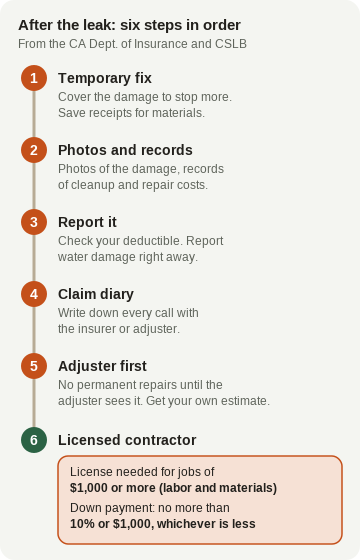
- Temporary fix. Save receipts [1][2].
- Photos and records of costs [1].
- Check the deductible. Report water damage right away [1][2].
- Claim diary of every call [1].
- Adjuster sees it before permanent repairs. Get your own estimate [1].
- Licensed contractor for jobs of $1,000 or more. Down payment no more than 10% or $1,000, whichever is less [3].
Who this applies to
- Homeowners with a leak right now, or a stain that showed up after the last storm.
- Anyone with an older roof, or trees over the house, who wants a plan before the next storm.
- If you rent, tell your landlord about the leak right away and take your own photos.
Before the next storm
- Clear gutters and downspouts so water runs off the roof edge. See our gutters and roof debris guide.
- Look at the roof from the ground with binoculars on a dry day: missing or lifted shingles, branches resting on it.
- Trim branches over the roof, and know who handles trees near power lines. See how to prepare your house for high winds.
- Keep a tarp, buckets, towels and a flashlight where you can find them in the dark.
- Make a home inventory now, room by room. The claims guide calls video of your things before a loss an excellent way to document damage [2].
Related
- Gutters and roof debris before storms
- Home inventory for insurance
- Prepare your house for high winds
- Downed power line: what to do
- Winter storm checklist
- Home Ready Sonoma home
Sources
- California Department of Insurance: Top Ten Tips for People Affected by Winter Storms (policy copy within 30 days, flood and water damage, fallen trees, deductibles, temporary repairs, photos and records, adjuster first, claim diary, estimates, contractors, hotline; read November 22, 2026)
- California Department of Insurance: Residential Property Claims Guide (cover damage to roof, walls, doors and windows, save receipts, report water damage right away, mold, video inventory; read November 22, 2026)
- Contractors State License Board: Contractors Board Warns Consumers About Unlicensed Contractors After Disasters ($1,000 license threshold, down payment limit, three bids and a written contract, license check, phone; read November 22, 2026)
- PG&E: Severe weather safety (downed lines, call 9-1-1 then PG&E, flashlight and radio, LED candles; read November 22, 2026)