What California home insurers look for
Wildfire, insurer by insurer. Updated October 19, 2026.
Start with a free check of your address. It shows your fire hazard zone and what to ask your insurer.
Why insurers got so picky
Your premium is the price of your policy. An insurer stays in business when the claims it pays add up to less than the premiums it collects. Most years in California, that is easy. Big fire years break it.
The chart shows losses for every $1 of premium. Look for the three tall bars.
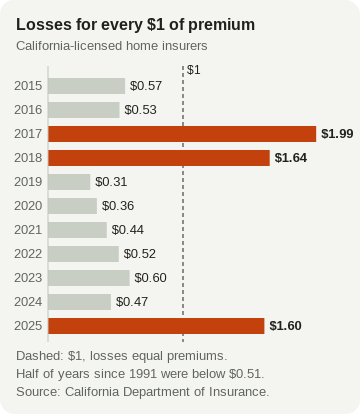
- A normal year: about 51 cents in losses for every $1 of premium. From 1991 to 2025, half the years were higher and half were lower, by our calculation [1].
- 2017: about $1.99. That was the year of the October 2017 fires here in the North Bay. The state counted more than $11.79 billion in losses from the October and December 2017 fires [4].
- 2018: about $1.64.
- 2025: about $1.60, the year of the Los Angeles fires. By the end of 2025, insurers had paid $22.4 billion on 42,121 claims from the Palisades and Eaton fires [5].
In 35 years, losses beat premiums only four times: 1991, 2017, 2018 and 2025. Three of the four were 2017 or later.
Premiums climbed too. Californians paid insurers $16.4 billion for home insurance in 2025, more than twice the $7.4 billion of 2015 [1].
The Department of Insurance prints its own figure for 2025: losses of 170% of premium, because it divides by premium earned during the year. We use premium written, which gives $1.60. Either way, losses topped premiums.
Our take: years like these are why insurers now want proof that a home can stand up to embers. You can't change the state's fire hazard map. You can change the house and the 5-foot zone around it, and show that you did.
How insurers decide
- A wildfire risk score. Insurers give your home a wildfire risk score. Your insurer must share your score when you apply, before it renews or drops your policy, and when you ask after finishing safety work. You can appeal it [6].
- Your home's features. The roof, vents, eaves, windows and the first 5 feet.
- Proof. Some insurers want an inspection by an approved inspector. Others accept your own photos [7].
- Your neighborhood. Some discounts depend on how far apart homes are, or on being in a Firewise community, a neighborhood with a recognized fire safety program [7].
Insurer by insurer
Rules change often. Use this as a starting point, then confirm with your insurer or agent.
Two terms first. The wildfire part of the premium is the share of your bill priced for fire risk, not the whole bill. WPH has two levels: Essential (it used to be called Base) for embers, and Enhanced (it used to be called Plus), which adds protection from flames and heat [8].
The table sums up what each one offers for fire safety work. Details and sources follow.
| Insurer | What it offers |
|---|---|
| State Farm | 5% off the premium with WPH Essential. Asked to sell new policies to WPH homes again; pending. |
| CSAA (AAA) | Won't drop a WPH home for wildfire risk for 3 years. |
| Mercury | 22.5% to 50% off the wildfire part, by WPH level and home spacing. |
| FAIR Plan | Up to 16.4% off the wildfire part. |
| Farmers | A discount for doing several measures. Ask for amounts. |
| USAA | Several discounts. They multiply, not add. |
| Allstate | Filed to return for new customers. Not open yet. |
State Farm
Has not taken new home customers in California since May 2023. On September 18, 2026 it asked the state to let it sell new policies again for homes with the WPH Enhanced designation anywhere in the state, and for WPH Essential homes in low and moderate risk areas. The state is still reviewing it, and State Farm is not open yet [9]. At a June 2026 meeting it listed 5% off the whole premium with the Essential (then Base) designation, and 2% for a Firewise community [10].
CSAA (AAA Northern California)
Offers up to a 15% discount for wildfire safety work. Says it will not drop a home with the WPH designation for wildfire risk, and will renew it for at least three years [3] [7].
Mercury
Since July 1, 2026, Mercury can offer bigger wildfire discounts. With WPH: 22.5% to 37.5% off the wildfire part of the premium. With WPH Enhanced: 30% to 50%. The low end is for homes about 10 feet or less from the next building, the high end for 30 feet or more. Mercury says the work does not guarantee you will be insured or renewed [11].
California FAIR Plan
The state's insurer of last resort, for homes no regular insurer will take. It offers up to 12 discounts, worth up to 16.4% off the wildfire part of the premium. Two are about the first 5 feet [12].
Farmers
Gives a discount for completing several safety measures [7]. The state lists it among insurers staying and growing in California [10]. Ask Farmers directly what it requires for homes in high fire risk areas.
USAA
Stacking several USAA discounts saves less than adding them up would suggest [7]. The state also lists it among insurers staying and growing in California [10].
Allstate
Filed on August 31, 2026 to start selling new home policies again, for the first time since 2022. The state is reviewing it, and Allstate is not open for new business yet [9].
What the designation takes
WPH requires a 5-foot noncombustible zone around the home and attached decks: no plants, no wood mulch, nothing that burns [2]. Essential targets embers. Enhanced adds protection from flames and heat [8]. A third party checks the work. The designation lasts three years, with reviews at years one and two. Applying costs $125 [2].
See our Wildfire Prepared Home checklist for the full list, and ember-resistant vents for the most common fix. Our sister site Zone Zero Guidelines sorts the 5-foot zone item by item.
On your whole bill, these discounts are small. In a Resources for the Future study of insurer filings, each discount for the 5-foot zone averaged about 0.5% to 1% of the full premium. Among insurers that take the discount off the whole premium, the full designation averaged about 3.8% [13]. Its bigger value is helping you get and keep coverage.
What to do
- Ask your insurer for your wildfire risk score and the list of discounts it gives. If the score looks wrong, appeal it [6].
- Ask which WPH level it recognizes, Essential or Enhanced, and what that is worth on your policy.
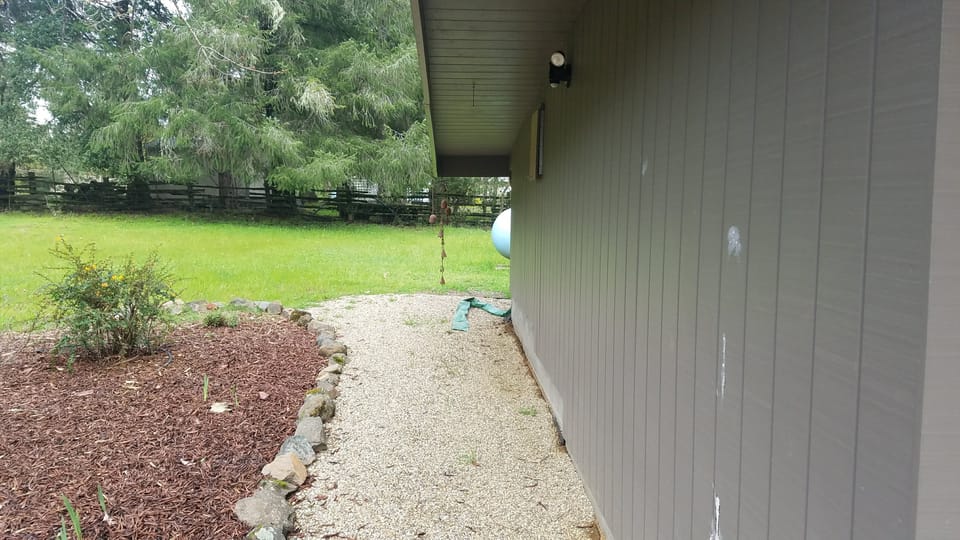
- Clear the 5-foot zone next to the house. The designation requires it, and two FAIR Plan discounts are about it [2] [12].
- Take dated photos of the work, before and after. Some insurers accept them as proof [7].
- Call an independent broker if you have been dropped. A broker can check several insurers at once. Our guide to being dropped (non-renewal) explains what to do next.
Also see How to keep your home insurance in a fire hazard zone.
We are not an insurance company, agent or broker, do not sell or recommend insurance, and are not affiliated with IBHS. This is not legal advice.
Related
Correction, October 18, 2026: an earlier version said the 5-foot zone alone averages 0.5% to 1% off the premium. In the Resources for the Future study, that is the average for each separate discount for the 5-foot zone.
Sources
- 1991-2025 California historical premium and loss, homeowners multiple peril, California Department of Insurance, 2025 Market Share Report, April 30, 2026
- About Wildfire Prepared Home, IBHS
- Wildfire mitigation resources, CSAA Insurance Group
- California statewide wildfire insurance claims nearly $12 billion, California Department of Insurance, January 31, 2018
- $22.4 billion in insurance payments are leading source of recovery in Los Angeles, California Department of Insurance, December 31, 2025
- Safer from Wildfires regulation FAQ, California Department of Insurance
- Do California insurers reward wildfire resilience?, Insurance for Good, review of rate filings as of January 2026
- IBHS updates Wildfire Prepared Home requirements, IBHS, June 2026 (Base renamed Essential, Plus renamed Enhanced)
- Major California home insurers move to reopen for new business, California Department of Insurance, September 18, 2026
- WRAP resource center, United Policyholders (State Farm presentation, June 2026; Department of Insurance list, May 2026)
- Wildfire mitigation discounts, Mercury Insurance
- Discounts for dwelling fire policies, California FAIR Plan, November 2025
- Wildfire mitigation discounts working paper, Resources for the Future, December 2025