Tree fell on your house? What to do first
If a tree fell on your house, get everyone out of the damaged rooms, stay away from any wires, take photos, cover the hole and call your insurer. The tree itself can wait.
The short answer
- Get everyone out of the damaged rooms. Stay out from under the tree.
- Look for wires. If a wire is down or the tree is on a line, stay at least 10 feet away. Call 9-1-1, then PG&E at 1-800-743-5000 [4].
- Take photos before anything is moved [1].
- Call your insurance company to report the damage [1][2].
- Cover the hole to stop more damage, and save every receipt [1][2].
- Wait on permanent repairs until the adjuster has seen the damage [1].
Right now: stay safe
These first steps are our tips, except where a source is linked.
- Get out of the rooms under the tree. A tree can shift, and a cracked ceiling can drop.
- Check for people and pets. If anyone is hurt or trapped, call 9-1-1.
- Look up before you go outside. PG&E says to call 9-1-1 right away for a tree hazard emergency, and to keep people and tools at least 10 feet from power lines [4].
- Treat any fallen wire as live. Our downed power line guide has the details.
- Don't climb on the roof or cut the tree yourself. A tree resting on a house is under strain. Cutting it can make it move.
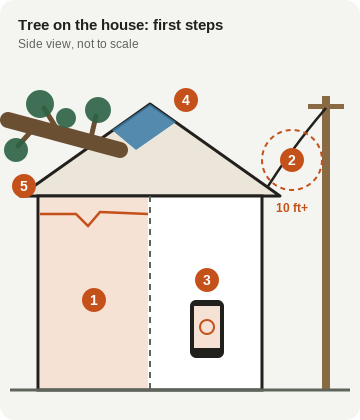
- Get everyone out of the damaged rooms and keep them out.
- Wire down or tree on a line: stay 10 feet or more away. Call 9-1-1, then PG&E [4].
- Photos before anything is moved [1].
- Temporary cover over the hole. Save receipts [1][2].
- Leave the tree for a licensed tree service.
Take photos and report the damage
The Department of Insurance says to call your insurance company to report the damage and take pictures [1]. Photograph it before the tree is moved:
- The whole tree and where it landed, from a few angles, from the ground.
- Inside: the ceiling, walls, floors and anything broken or wet.
- Fences, cars, sheds and anything else the tree hit.
- Where the tree came from: the stump, the roots, a broken trunk.
Keep records of all cleanup and repair costs [1]. Write down every call with your insurer or adjuster: the date, who you talked to and what they said [1][3].
A home inventory made before a storm makes this much easier. See our home inventory guide.
Cover the hole, but keep it temporary
The Department of Insurance says to make temporary repairs to keep your property from further damage. It also says not to make permanent repairs until the insurance adjuster sees the damage [1].
Its claims guide says the insurer reimburses reasonable costs to protect the property, as long as you save the receipts for materials you buy [2].
In practice that usually means a tarp over the hole once the tree is off that spot. Our tip: let a tree service move the tree first, and have the tarp put on in dry, calm weather by someone with the right gear.
Water got in? Our roof leak guide covers the drips, the buckets and the mold.
Does insurance cover a tree falling on a house?
Usually, but read your own policy. The Department of Insurance says [1]:
- Damage from fallen trees is generally covered under standard homeowners policies. There may be exceptions, so check with your agent or insurer.
- A car hit by a fallen tree is generally covered under the comprehensive part of an auto policy.
- Homeowners policies typically exclude flood, mudslide and debris flow.
Its claims guide adds two things to look for in your policy [2]:
- Trees and shrubs themselves are covered only on a limited basis.
- Debris removal is also limited, and it counts toward your coverage limit.
You can ask your insurer for a full copy of your policy. The law requires them to send it free within 30 days of your request [3]. If the adjuster says something is excluded or limited, ask them to show you the exact part of the policy [3].
If you can't live at home during repairs, keep receipts for the extra costs. The claims guide says insurers usually advance money for these [2].
What if it was your neighbor's tree?
Whether a neighbor has to pay is a legal question, and we can't decide it for you. Our statewide site explains how fault works and how to get your deductible back.
Either way, report the damage to your own insurer [2]. Ask them how they handle a tree that came from next door.
Questions or problems with a claim? The Department of Insurance hotline is 800-927-4357 [1]. It can also open a review of your claim [2].
Who to call in Sonoma County
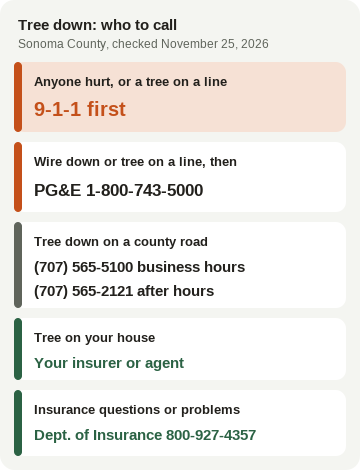
- Tree on a power line, or anyone hurt: 9-1-1 first [4].
- Tree hazard near PG&E lines: PG&E at 1-800-743-5000 [4].
- Tree down on a county road: (707) 565-5100 in business hours, or the Sheriff at (707) 565-2121 after hours [5]. Inside a city limit, check with your city.
- Tree on your house: your insurance company or agent [1].
Hiring someone to remove the tree and fix the house
After a storm, take your time choosing who does the work. The Contractors State License Board says [6]:
- Work totaling $1,000 or more in labor and materials must be done by a licensed contractor.
- Don't pay more than 10 percent down or $1,000, whichever is less.
- Get three bids, check references, and get a written contract.
- Check the license at cslb.ca.gov.
The Department of Insurance's claims guide says to get written bids from licensed contractors, with the materials and prices listed line by line [2].
Who this applies to
- Homeowners with a tree or big limb on the house, the garage or a fence right now.
- Anyone with big trees over the roof, who wants a plan before the next storm.
- If you rent, tell your landlord right away and take your own photos.
Before the next storm
- Look up at your trees on a dry day. Note dead, leaning or cracked limbs over the roof, the driveway and the power line.
- Know who trims what. PG&E trims around its lines. The wire from the pole to your house is yours to keep clear of dead or hazardous trees [4]. Our trees near power lines guide explains it.
- Get ready for wind. See how to prepare your house for high winds.
- Make a home inventory and keep a copy of your policy where you can find it.

Related
- Roof leaking during a storm? What to do first
- Trees near power lines: who is responsible?
- Downed power line: what to do
- Home inventory for insurance
- Free storm help in Sonoma County
- Home Ready Sonoma home
Sources
- California Department of Insurance: Commissioner alerts consumers about insurance coverage following winter storms (2025 consumer alert: fallen trees generally covered, cars under comprehensive, flood and mudslide exclusions, report and take pictures, keep records, temporary repairs, adjuster before permanent repairs, document calls, hotline; read November 25, 2026)
- California Department of Insurance: Residential Property Claims Guide (report the damage, temporary repairs and receipts, limited coverage for trees and shrubs and for debris removal, living expenses, written bids, Request for Assistance; read November 25, 2026)
- California Department of Insurance: Top Ten Tips for People Affected by Winter Storms (policy copy within 30 days, claim diary, ask the adjuster to point to the policy language; read November 22, 2026)
- PG&E: Trees and powerlines (call 9-1-1 for a tree hazard emergency, then 1-800-743-5000, keep 10 feet from lines, service drops are the owner's to keep clear; snapshot November 24, 2026)
- County of Sonoma: Road obstructions (who to call for a tree down on a county road; checked November 24, 2026)
- Contractors State License Board: Contractors Board Warns Consumers About Unlicensed Contractors After Disasters ($1,000 license threshold, down payment limit, three bids and a written contract, license check; read November 22, 2026)