Defensible space zones around your home
What to clear at 5, 30 and 100 feet, how much ground that is, and who checks it in Sonoma County.
Updated October 22, 2026.
Defensible space is the ground around your buildings that you keep clear, so a wildfire loses strength before it reaches the walls. It also gives firefighters a safer place to work [1].
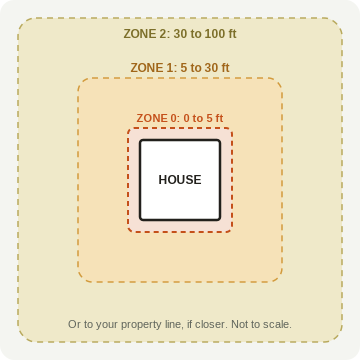
California measures it in zones, starting at the wall [2]:
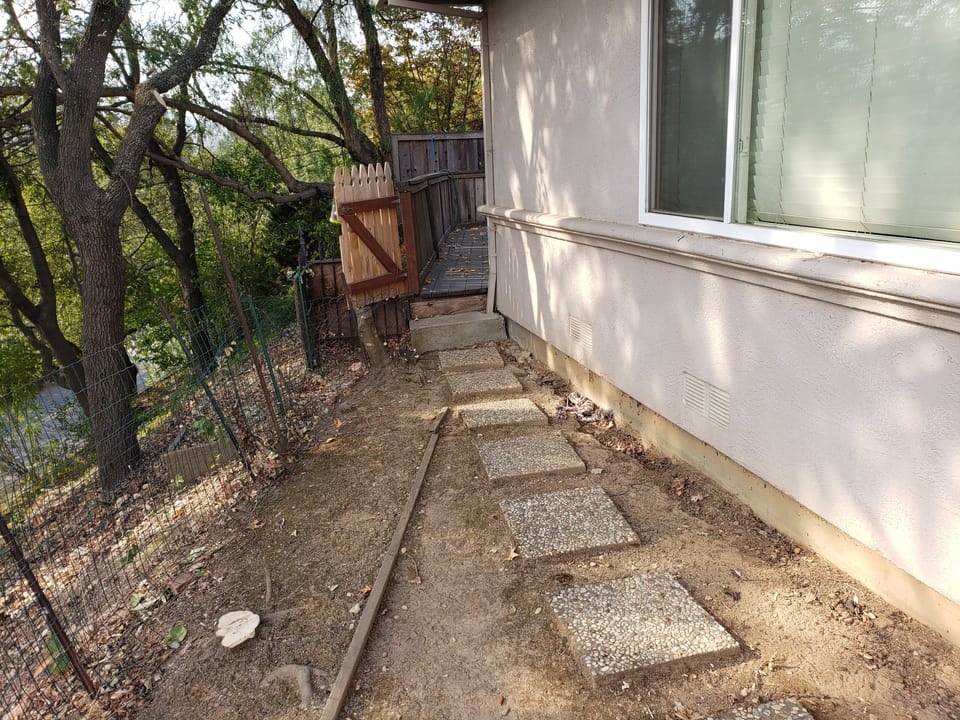
- Zone 0: the first 5 feet. Keep it free of anything that burns [1]. The Board of Forestry's Zone 0 rule for it is not in force.
- Zone 1: the first 30 feet, including Zone 0. Nothing dead, and nothing that burns piled against the house.
- Zone 2: 30 to 100 feet, or to your property line if that comes first. Short grass and space between plants.
Why it matters here: about 1 in 3 Sonoma County homes inspected in state fire areas since July had something to fix, in counts published by CAL FIRE, the state fire agency (chart below). And in the 2022 Oak Fire in Mariposa County, homes that met the rules were 6 times more likely to survive, the state's wildfire task force reports [11].
Does this apply to you? Check your address first.
- Outside city limits in Sonoma County: yes, on every property [7].
- Inside a city: yes, if your address is in a Very High fire hazard zone, the highest level on the state's fire hazard map [4].
- On land where the state, not a city, fights wildfires (a State Responsibility Area): yes, in any fire hazard zone [3].
Start this week
- Clear leaves and needles off the roof and out of the gutters.
- Pull dead plants, dead leaves and needles within 30 feet of the house.
- Move firewood out past 30 feet, unless it is completely covered in fire-resistant material.
All three are already the law where defensible space applies [2].
How much ground is in each zone?
This calculator shows how many square feet you have in each zone, so you know how big the job is.
- Tap how many buildings are on the property.
- For each one, tap its size and the shape closest to it.
- Tap your lot size. The ground in each zone shows below.
Count the house, garage, sheds, barns and cottages.
A rough guide. Count an attached deck as part of the house. Each building's zones are counted on their own, so if buildings sit close together the real total is a bit smaller. Zones stop at your property line.
For a typical house with no property line in the way, the table shows how the ground adds up. Look at how fast it grows past 30 feet. Your result above can be smaller, because zones stop at your property line.
| House, ground floor | Zone 0 0 to 5 ft | Rest of Zone 1 5 to 30 ft | Zone 2 30 to 100 ft |
|---|---|---|---|
| 1,000 | 710 | 5,900 | 37,400 |
| 2,000 | 970 | 7,200 | 41,100 |
| 3,200 | 1,210 | 8,400 | 44,400 |
All numbers are square feet.
Our calculation from the zone distances in state rules [2]. Method: a square, one-story house, each band measured out from the walls, rounded.
Around one 2,000 square foot house, the house and its first 30 feet cover about 10,200 square feet. That is almost all of a quarter-acre lot (10,890 square feet). On a lot that size, the rest of your 100 feet is on your neighbors' land. You are only responsible up to your property line [2].
What to clear in each zone
Tap each item when it is done. Items marked "law now" are already required where defensible space applies [2][3]. The rest of the Zone 0 items are CAL FIRE's guidance [1].
Board of Forestry rule (proposed): not in force. The Board adopted it, then pulled it back from state review on September 8, 2026 [12]. On November 5, 2026, it adopted a revised rule. It plans to send it for state review on or after November 13. There is no start date yet [15]. State law says CAL FIRE cannot start checking the first 5 feet until the State Fire Marshal finds the Legislature has paid for it [3].
Zone 0: the first 5 feet
5 to 30 feet (rest of Zone 1)
Zone 2 is the outer ring. Here the goal is less fuel, not bare ground.
Zone 2: 30 to 100 feet
0 of 17 done.
Our take on grass: cut it to 4 inches everywhere you clear. The county allows 6 inches near homes on locally protected land (a Local Responsibility Area) and asks for 4 inches along the road [8]. The state asks for 4 inches from 30 to 100 feet [2]. So 4 inches meets both.
Our take on firewood: move it past 30 feet, then keep 10 feet of bare ground around the pile. That meets the law in both zones.
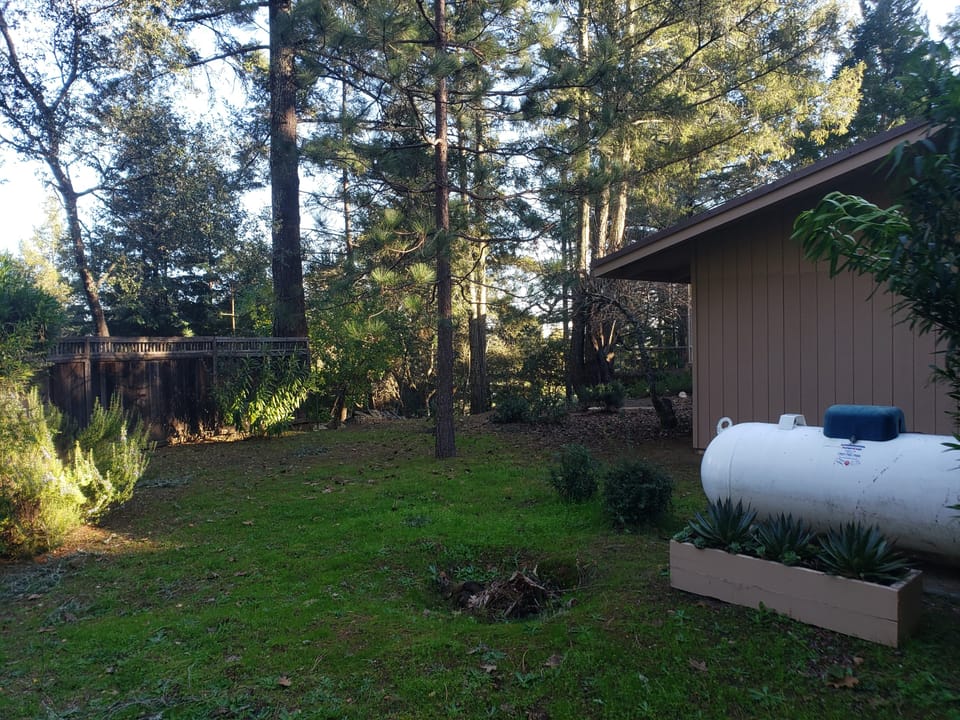
Do not scrape the ground bare, and keep heavy equipment out of creeks and drainages. Bare soil erodes, most of all on steep slopes [2].
Insurers care about the first 5 feet too. To earn a Wildfire Prepared Home label from IBHS (the Insurance Institute for Business & Home Safety, a research group funded by insurers), the first 5 feet must hold nothing that burns: no plants, wood mulch, or wood or vinyl fencing [16]. AAA's insurer, CSAA, says it will renew its current customers' single-family homes with that label for at least 3 years, if policy conditions are met [14]. The label does not guarantee coverage. What insurers look for · How to keep your insurance.
Correction, October 18, 2026: the fence item now covers any fence, gate or arbor attached to the house, not only wood fences.
Local rules can be stricter. Zone 0 items follow CAL FIRE's guidance [1]. See our Zone 0 guide, or Zone Zero Guidelines, our sister site, for every item statewide.
How far apart to space plants
Spacing keeps fire from spreading from plant to plant, or climbing from grass to shrubs to treetops like a ladder [1]. It matters most in Zone 2, where plants can stay.
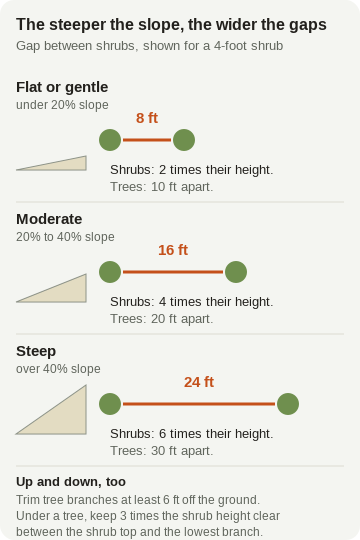
Slope changes the answer. Slope is how much the ground rises as you walk uphill: a 20% slope rises 2 feet for every 10 feet. On steeper ground, CAL FIRE's guidance asks for wider gaps [1].
The chart shows the gap for each slope. Find the row that matches your yard.
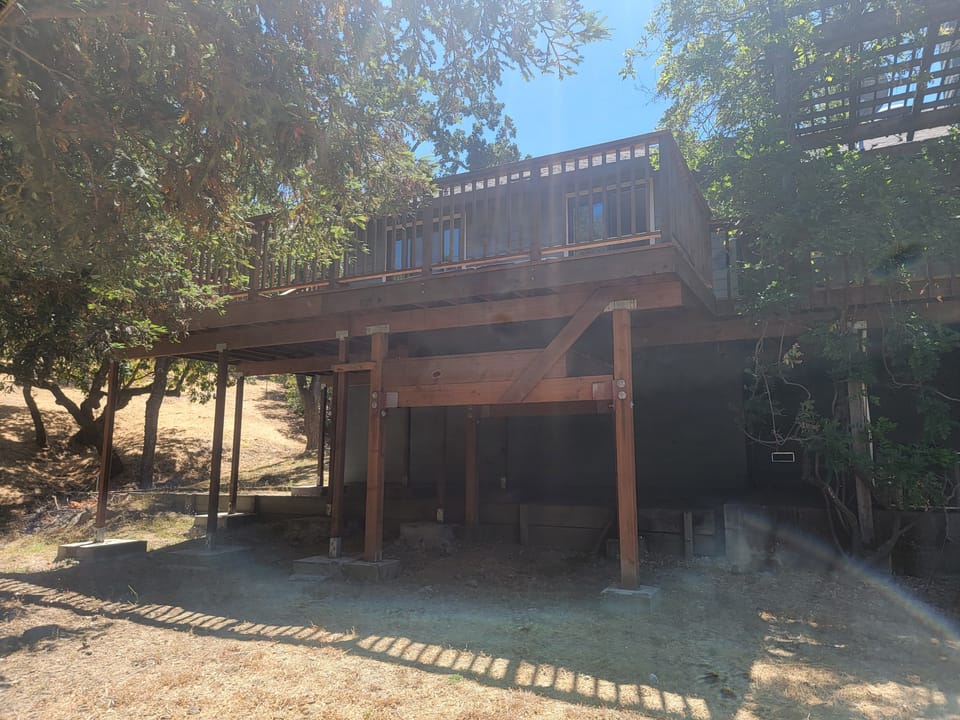
The space under a deck counts too. Clear plants and anything that can burn from under decks, balconies and stairs [2].
Who checks it in Sonoma County
Outside city limits, inspectors from Permit Sonoma (the county's permit and fire prevention office) and local fire districts check homes, starting in late spring. They do about 4,000 or more inspections a year [6].
The chart uses CAL FIRE's published counts, for State Responsibility Areas only [9]. It shows the share of homes marked non-compliant, meaning they had something to fix. Compare Sonoma's bar with the statewide one.
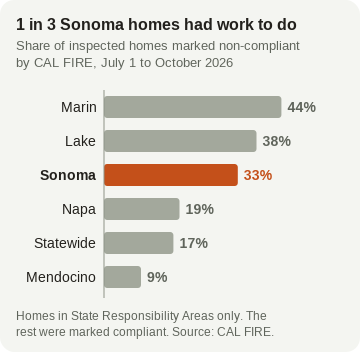
These counts start July 1, so they cover only part of a year. For a longer view: in 2019-20, 14% of CAL FIRE's inspections statewide found something to fix [10]. This year so far: 17% statewide, 33% in Sonoma County.
If you fail an inspection
- Fix it within 30 days. You get a written report, left at the property and mailed to the owner. Then comes a second visit, which can carry a fee [6].
- Fail again, and you have 15 days to fix it or ask for a hearing in writing [6].
- Still not done? The county can do the work. Unpaid costs, fees and penalties can become a lien, a legal claim against the property [7].
In State Responsibility Areas, state law sets a fine of $100 to $500 the first time, and $250 to $500 for a second within 5 years. A third within 5 years is a misdemeanor, which is a crime, with a fine of at least $500 [5].
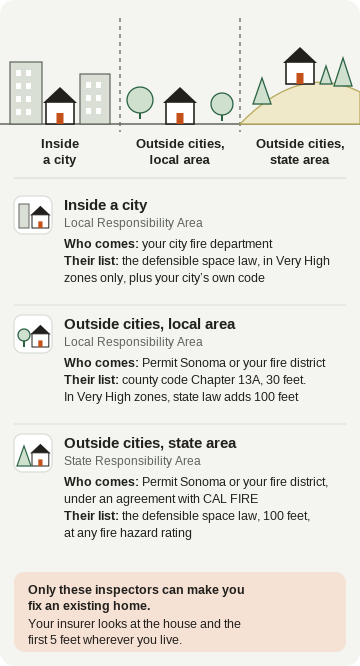
Who comes to your door depends on where you live. The drawing shows the three cases.
Extra county rules outside State Responsibility Areas
On a home in a Local Responsibility Area (where a local fire agency, not the state, fights wildfires) outside city limits, the county adds these [8]:
- Cut grass to 6 inches or less within 30 feet. Do not scrape it to bare soil.
- Trim tree limbs up to 6 feet off the ground.
- Put a spark arrester on the chimney: a wire mesh cap with openings no bigger than 1/2 inch.
- Post address numbers at least 4 inches tall that you can read from the road.
- Along the road, clear 10 feet: no dead plants, limbs 6 feet up, grass 4 inches.
For the full picture of who enforces what, see Sonoma County fire rules: who checks what.
Free chipping for the brush you cut
Permit Sonoma chips cut brush for free for homes outside city limits, usually May to October [6]. Stack limbs 1 to 4 inches thick and up to 10 feet long, cut ends facing the road, within 10 feet of your driveway or road. No leaves, grass, poison oak, broom or blackberries [13].
Want it done for you?
We clear brush and debris for homes in Sonoma County. Tap below and we fill in a quote request from your answers above. About our clearing.
Your clearing quote request
We filled in what you entered above. Add the rest and send it.
Request sent. Devan will be in touch to confirm details and give you a price.
Want a faster answer? Text 707-394-5094.
Sources
- CAL FIRE: Defensible Space (zones, what to do in each, tree and shrub spacing by slope; read October 22, 2026)
- California Code of Regulations, Title 14, Section 1299.03 (Zone 1 and Zone 2 requirements, outbuildings and propane tanks, soil and creeks; read October 22, 2026)
- Public Resources Code 4291 (defensible space in State Responsibility Areas; read October 22, 2026)
- Government Code 51182 (Very High fire hazard zones in Local Responsibility Areas; read October 22, 2026)
- Public Resources Code 4291.1 (fines; read October 22, 2026)
- Permit Sonoma: Defensible Space Inspections FAQs (4,000+ inspections a year, deadlines, reinspection fees, chipper season; read October 22, 2026)
- Permit Sonoma: Hazardous Vegetation Inspection & Abatement (required in all of unincorporated Sonoma County, abatement and liens; read October 22, 2026)
- Permit Sonoma: Vegetation Management Requirements & Recommendations (county rules for Local Responsibility Areas; read October 22, 2026)
- CAL FIRE: Defensible Space Public Dashboard (inspections by county, fiscal year 2026-27; data read October 22, 2026)
- Legislative Analyst's Office: Reducing the Destructiveness of Wildfires, 2021 (86% of CAL FIRE inspections compliant in 2019-20)
- California Wildfire & Forest Resilience Task Force: Defensible Space Inspectors (Oak Fire, 6 times more likely to survive; read October 22, 2026)
- Office of Administrative Law: Recent actions on emergency regulations (Board of Forestry rule withdrawn September 8, 2026; read October 22, 2026)
- Permit Sonoma: Sonoma County Chipper Program (pile rules; read October 22, 2026)
- CSAA Insurance Group: Wildfire Mitigation Resources (3-year renewal for designated homes; read October 22, 2026)
- Board of Forestry: Notice of emergency action, Zone 0 (revised rule adopted November 5, 2026; to be sent for state review on or after November 13; read November 7, 2026)
- IBHS: About Wildfire Prepared Home (0 to 5 foot noncombustible zone, what must be removed; read October 22, 2026)