Sonoma County fire rules: who checks what
Sonoma County defensible space requirements, Zone 0 and insurers, sorted by who checks your home. As of October 18, 2026.
Live in Sonoma County and you've likely heard about Zone 0 more than once this year.
After 2017, 2019 and 2020, fire is never far from mind here. When new rules come up, people listen. The trouble is, everyone tells it differently.
A neighbor says the county will fine you over your mulch. A contractor says Zone 0 isn't law yet. Your insurer sends its own list. They can't all be right.
The good news: they're mostly talking about different things. This article untangles them for Sonoma County: who actually comes to your door, what they check, what's coming, and what your insurer wants.
Where things stand today
Outside city limits, Permit Sonoma and local fire districts do about 4,000 defensible space inspections a year, starting in late spring [1]. Defensible space is the cleared and thinned ground around a house, out to 100 feet or your property line. The law splits it in two: Zone 1, the first 30 feet, and Zone 2, from 30 to 100 feet.
That is the rule with teeth. Zone 0, the first 5 feet around a house, gets the headlines. Zone 1 already covers some of it, but the new Zone 0 rule is not in force. Meanwhile your insurer already looks closer than either.
Which rules land on you depends on where your home sits on two state maps, and whether it is inside a city.
- State Responsibility Area: land where the state, through CAL FIRE (the state fire agency), fights wildfires. Mostly rural land outside cities.
- Local Responsibility Area: land covered by a city, the county or a local fire district.
- Fire hazard rating: CAL FIRE rates land Moderate, High or Very High for wildfire hazard.
Which list applies to me?
- Run your address through our free fire zone check. It shows whether you are in a State or Local Responsibility Area, and your fire hazard rating.
- Pick your answers below.
- Read what applies to your home today, and what would change.
Pick your answers to see which rules apply.
Outside Sonoma County? The statewide version is on our sister site, Home Ready California.
Who checks what in Sonoma County
Three terms. The building code is the state's construction rules, checked when you get a permit. IBHS is the Insurance Institute for Business and Home Safety. Wildfire Prepared Home is its voluntary designation for homes that meet its checklist [2].
Look at the last column. Only the first row can make you fix an existing home.
| Who | What they check | Whose home | Can they make you? |
|---|---|---|---|
| Fire inspector | Defensible space out to 100 feet, roof, chimney clearance | Outside cities: Permit Sonoma or your fire district. In a city: your city fire department | Yes. Fix notices, fees, clearing at your cost |
| Building inspector | Ember-resistant building: roof, vents, siding, doors | New homes, additions and replaced parts in fire hazard zones | Only for the work you are permitting |
| IBHS evaluator | The house plus 0 to 30 feet, against the Wildfire Prepared Home standard | Only owners who apply | No. They document, you pass or not |
| Your insurer | The house and the first 5 feet, mostly from aerial images and risk models | Every policyholder | Not by law, but they can price you up or not renew |
| Consultant | Advice mixing IBHS, building code and best practice | Whoever hires them | No. A report is not the law |
Is any of this actually law?
Some of it. Three layers sit on top of each other.
- Law now: defensible space. The 100 feet around a building, in two zones. State law requires it where it applies [3].
- Coming: Zone 0. The first 5 feet, kept free of things that burn. It is written into state law, but the rule that would switch it on is not in force.
- Insurers. They already act on the first 5 feet and the house itself.
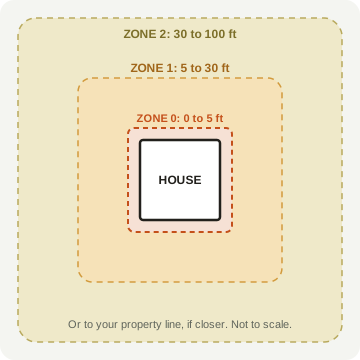
Our defensible space calculator measures the zones on your lot.
Does the 100-foot rule apply to my home?
It depends on your responsibility area, your fire hazard rating and whether you are inside a city.
Find your home in one of the three places below. Each shows who inspects it and which list they use.
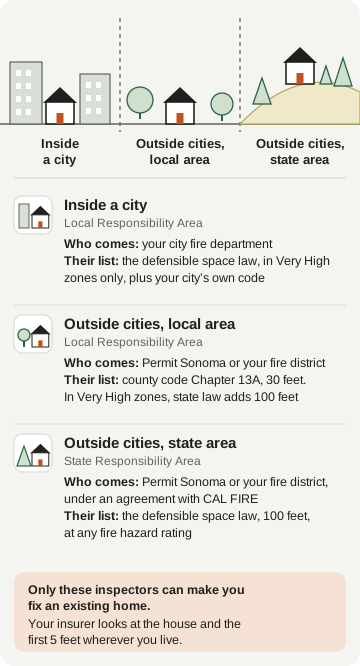
Outside city limits, State Responsibility Area
The state 100-foot rule covers every building, at any rating, Moderate included. That has been true since January 1, 2025 [3] [4]. Sonoma County's own code points to the same state rules here [5].
Outside city limits, Local Responsibility Area
Sonoma County's Chapter 13A applies. It is the county's defensible space ordinance for unincorporated land [5]. For homes, the list is:
- 30 feet of defensible space, and up to 100 feet on steep or heavily grown land.
- Grass 6 inches or less, but not scraped to bare soil.
- Tree branches limbed up 6 feet from the ground.
- Roof and gutters clear of leaves and needles.
- No part of a tree within 10 feet of a chimney, and a spark arrester with openings of 1/2 inch or less.
- Address numbers at least 4 inches tall, visible from the road.
- 10 feet cleared along the roadside.
In a Very High zone, state law also asks for the full 100 feet [6].
Inside a city
Cities are Local Responsibility Areas. The state 100-foot rule applies there only in Very High zones, unless a city code adds more [6]. Your city's fire department handles it.
Santa Rosa is the big change this year. Its wildland-urban interface area, where the city's vegetation rules apply, now includes High and Very High zones, effective July 2, 2026 [7] [8]. Homes in the added areas keep dry grass at 4 inches during fire season [9].
We found no local Zone 0 rule in any Sonoma County city or fire district as of October 18, 2026.
Who comes to inspect, and when
Under an agreement with CAL FIRE, Sonoma County is the inspection authority [10]. Inside a city, your city fire department handles it instead.
- Who: outside city limits, an inspector from Permit Sonoma's Fire Prevention Division or your fire district [1].
- When: usually from late spring or early summer [1].
- What: 100 feet around the home, or to the property line, and 10 feet along roads and driveways [1].
Selling a home? In a State Responsibility Area rated High or Very High, the seller gives the buyer proof of a defensible space inspection from the last 6 months, or the buyer agrees in writing to comply within a year [11]. Permit Sonoma does these inspections for a fee. To book one, email FirePrevention@sonomacounty.gov [12].
What happens if you fail
- First fail: 30 calendar days to fix it [1].
- Second fail: 15 days to fix it or ask for a hearing. Reinspection fees can apply [1].
- After a hearing: 10 business days. A hearing officer can order the county to clear it, and you can owe hearing costs [1].
- Unpaid costs: the county can put a lien on the property [5].
State law also sets fines: $100 to $500 for a first violation, and a misdemeanor on the third [13]. They are rare. In 2019-20, CAL FIRE and its partner counties wrote fewer than 1,000 citations statewide, against more than 200,000 inspections a year [14].
What is already required within 5 feet
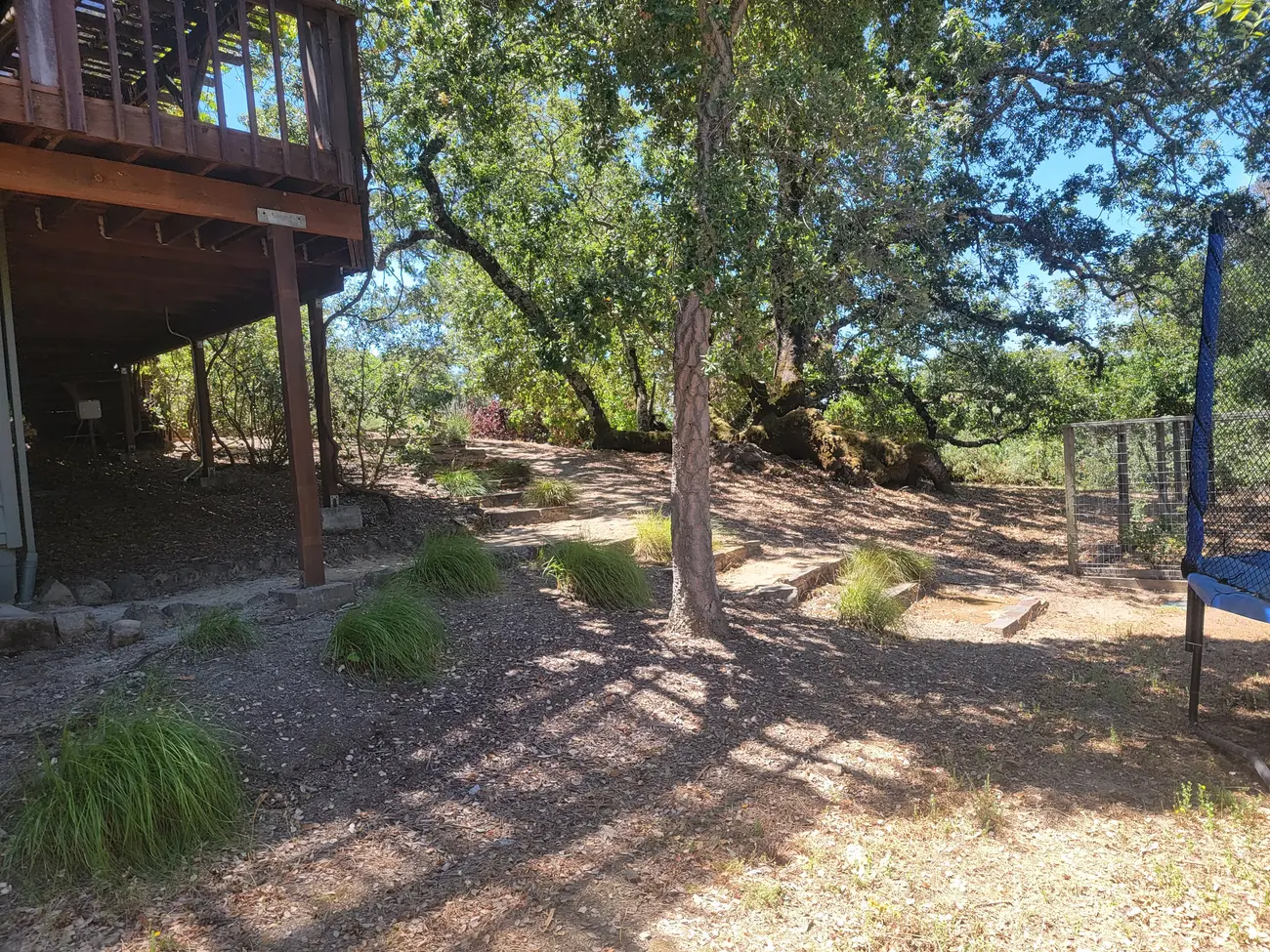
Some near-house duties are already law wherever the 100-foot rule applies [3] [15]:
- Roof: free of leaves, needles and other plant debris.
- Chimney: no part of a tree within 10 feet of the outlet.
- Dead wood: none on plants next to or over the house.
- Under decks and stairs: cleared of plants and stored things that burn.
- Firewood: out of the first 30 feet, unless fully covered with fire-resistant material.
What gets mixed up
Each tag says who asks for it.
- Building codeGarage door gaps of 1/8 inch or less. Required for new or replaced garage doors in fire hazard zones, by the California Wildland-Urban Interface Code, the state's ember-resistant building rules [16]. Not required for the door you have now.
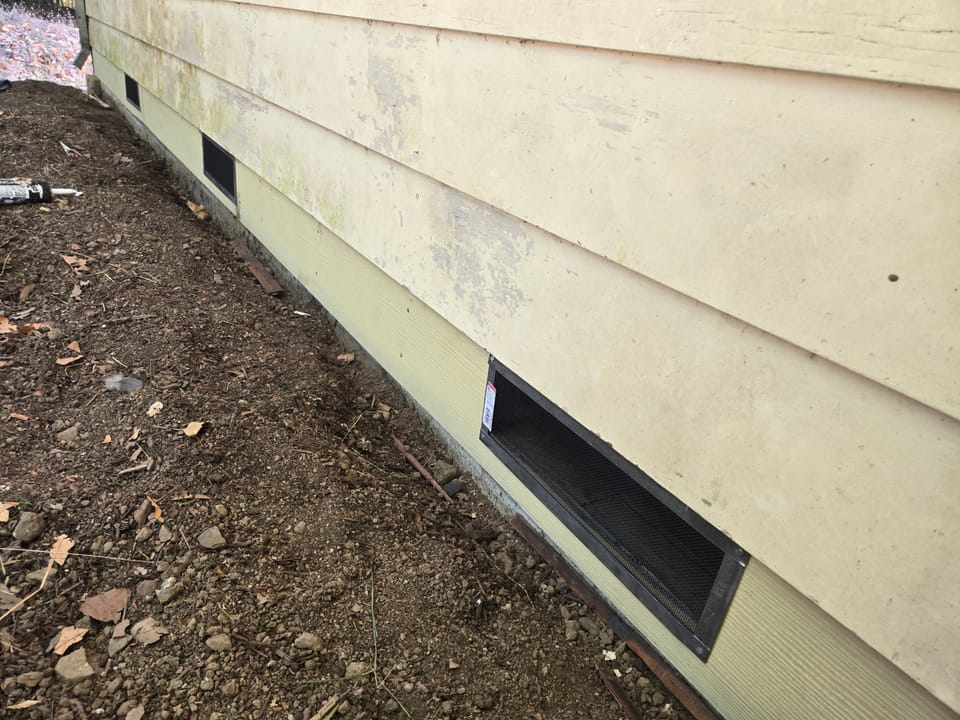
- IBHS6 inches of noncombustible wall base. A Wildfire Prepared Home requirement [17]. Not law for existing homes.
- IBHS1/8 inch mesh on vents. Wildfire Prepared Home asks for it, or ember-resistant vents. Dryer vents get no mesh [2].
- IBHSWood siding. The higher Wildfire Prepared Home level bans it, even treated. The first level allows it if the bottom 6 inches are noncombustible [2].
- IBHSZone 0, not in forceBark mulch by the house. State law in force today does not ban it. Wildfire Prepared Home does, and the Zone 0 rule would. How to swap bark for gravel.
What changes if Zone 0 takes effect
Where it stands. The Board of Forestry, the state board that writes these fire rules, adopted the new Zone 0 rule on August 19, 2026. It sent it to the Office of Administrative Law, the state office that reviews new rules, then withdrew it on September 8 [18]. As of October 18, 2026, it has not been refiled. It is not in force.
A 2025 law, AB 1455, lets the Board adopt it as an emergency rule and lets local fire agencies adopt alternatives that do the same job [19].
If it is refiled as adopted [20]:
- Who: every building in a State Responsibility Area, and occupied buildings in Very High zones in local areas.
- New buildings: comply from day one.
- Existing homes, right away: roof and gutters clear, dead branches gone, 10 feet from chimneys. Mostly already law.
- Within 3 years: nothing combustible in the first 5 feet, like mulch or firewood, and clear under decks.
- Within 5 years: plant-free strips by walls, windows, vents and decks, noncombustible fence sections where fences meet the house, and noncombustible sheds within 5 feet. In local areas the fire agency sets this between 3 and 5 years.
It covers the ground and attached items, not siding or garage doors. More in our Zone 0 guide.
What insurers and IBHS ask for
For most homeowners this is the list that matters most. It affects whether you can get or keep a policy.
Insurers that reward the work mostly point to Wildfire Prepared Home. Its first level, Essential (was Base), wants a bare first 5 feet with no exceptions: no plants, no wood or rubber mulch, no wood or vinyl fencing. It also covers the roof, gutters, vents, the bottom 6 inches of walls, under decks and defensible space to 30 feet. The higher level, Enhanced (was Plus), adds eaves, siding, windows, decks and sheds [2] [21].
Applying costs $125. The designation lasts 3 years, with photo reviews in years 1 and 2 [21]. Our Wildfire Prepared Home checklist goes item by item.
Where the designation counts so far:
- State Farm: asked the state on September 18, 2026 to let it write Enhanced homes statewide, and Essential homes in low and moderate zones. Pending, not open yet [22].
- AAA (CSAA): won't non-renew a designated home for wildfire risk for at least 3 years, as long as you keep the designation [23].
- Mercury: a discount on the wildfire part of the premium, 22.5% to 37.5%, more for Enhanced. No promise of a policy [24].
- FAIR Plan (the state's insurer of last resort): no discount for the designation. Its own wildfire discounts top out at 16.4% [25].
The honest part. Every insurer must offer discounts for listed work, like a clear 5 feet [26] [27]. But each 5-foot item averages 0.5% to 1% of the full premium. The full designation averages 3.8% [28]. The real prize is staying insurable, not the discount.
Insurers mostly judge homes from aerial images and risk models. If yours won't renew, it must tell you at least 75 days ahead, with the reasons [29]. You can ask for your wildfire risk score and how to lower it [27]. More in what each insurer looks for.
Our take. Pass your defensible space inspection first, since that is the law. Then do the first 5 feet and the vents. Insurers look at both now, and Zone 0 would require the first 5 feet.
What it means for you
- Check your address. State or Local Responsibility Area decides your list. Free fire zone check.
- Pass your inspection first: roof, chimney, grass, dead wood, out to 100 feet. Measure your zones.
- Then clear the first 5 feet. It is coming, and insurers want it now. Swap bark for gravel.
- Ask your insurer what it rewards before you spend on the house.
Related
Sources
- Defensible space inspections FAQs, Permit Sonoma (read October 18, 2026)
- Wildfire Prepared Home FAQs and requirements summary, IBHS (checked October 18, 2026)
- Public Resources Code 4291 (state defensible space law)
- SB 504 (2024), Digital Democracy (all structures in a State Responsibility Area, from January 1, 2025)
- Sonoma County Code Chapter 13A, as amended June 2020, County of Sonoma (read October 18, 2026)
- Government Code 51182 (Very High zones in Local Responsibility Areas)
- Wildland-Urban Interface, City of Santa Rosa (2026 map, read October 18, 2026)
- Firewise Oakmont newsletter, July 6, 2026 (Santa Rosa WUI area, effective July 2, 2026; PDF)
- Santa Rosa moves to expand wildfire risk zones, KRCB, April 20, 2026
- Fire Hazard Severity Zones, Permit Sonoma (read October 18, 2026)
- Civil Code 1102.19 (defensible space proof at sale)
- Property sales inspections (AB 38), Permit Sonoma (read October 18, 2026)
- Public Resources Code 4291.1 (fines)
- Legislative Analyst's Office report, 2021 (inspections and citations)
- 14 CCR 1299.03, Board of Forestry defensible space rules, and CAL FIRE defensible space
- California Wildland-Urban Interface Code 504.9.2 (garage door gaps)
- Wildfire Prepared Home technical standard: summary of changes, IBHS (section 2.1.4)
- Recent actions on emergency regulations, Office of Administrative Law (file 2026-0828-03E, read October 18, 2026)
- AB 1455 (2025), Digital Democracy
- Draft Zone 0 regulations summary, August 2026, Board of Forestry (copy hosted by UC ANR)
- About Wildfire Prepared Home and IBHS news release on the 2026 update
- Major California home insurers move to reopen for new business, including state's largest insurer, California Department of Insurance, September 18, 2026
- Wildfire mitigation resources, CSAA Insurance Group (AAA)
- Wildfire mitigation discounts, Mercury Insurance (from July 1, 2026)
- Discounts for dwelling fire policies, California FAIR Plan, November 2025
- Safer from Wildfires, California Department of Insurance
- FAQ on the Safer from Wildfires regulation, California Department of Insurance (PDF)
- Working paper 25-30, Resources for the Future, December 2025
- Insurance Code 678 (non-renewal notice)