Fire water tanks and roof sprinklers in Sonoma County
Turn winter rain into water a fire crew can use.
The short answer
Our take: the most useful fire water at home is a full tank a fire engine can hook up to.
Building on a parcel with a private well? The county fire code asks for at least 2,500 gallons of emergency water storage [1].
Roof sprinklers might help, but the research on them is thin [5]. They also need a lot of water, for hours [4].
Updated October 17, 2026. General information from Sonoma County, Permit Sonoma and fire safety groups. Not legal or engineering advice. Rules here are for unincorporated Sonoma County. Cities have their own.
What Sonoma County asks for
- 2,500 gallons or more of emergency water on parcels with a private well. Parcels on public water get a road hydrant within 250 feet of the driveway instead. Not building? The county does not ask you to add a tank [1].
- When it applies: new parcels and building permits in unincorporated Sonoma County. Additions and ADUs under 640 square feet are among the exceptions [1].
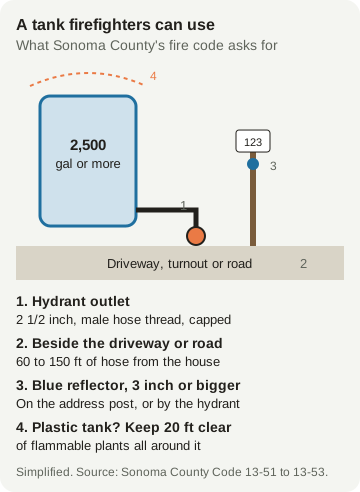
- A hydrant crews can use: at least one 2 1/2 inch outlet with male National Hose Threads, at a turnout, turnaround, along the driveway or along the road it meets, 60 to 150 feet of hose from the house. Longer driveways can go farther with more storage [1].
- A blue reflective marker, at least 3 inches across: on the address sign if the hydrant is on your driveway, or on a post within 3 feet of it along the road [1].
- Plastic tanks need at least 20 feet of clearance from flammable vegetation [1]. A best-practice sheet posted by Northern Sonoma County Fire adds noncombustible ground for the first 5 feet around any tank, and no branches over it [3].
- Over 5,000 gallons needs permits from the county building department and Sonoma County Fire. Tanks of 5,000 gallons or more need a concrete pad [2].
One thing to check: the county hydrant rule calls for a 2 1/2 inch outlet [1], while Permit Sonoma's tank bulletin asks permitted tanks (over 5,000 gallons) that are not part of a fire sprinkler or fire pump system to have a 4 inch outlet and valve crews can use in an emergency [2]. Ask Sonoma County Fire Prevention which fits your tank: (707) 565-2361 [2].
State zones, older homes and insurance
- State Responsibility Area or not. The state's Fire Safe Regulations set minimum wildfire standards for building in State Responsibility Areas and, since July 1, 2021, in Very High Fire Hazard Severity Zones. They apply to new parcels, new buildings, use permits and new roads. Their water rules, which apply when new parcels are approved, ask for the same 2 1/2 inch hose outlet and a blue marker within 3 feet [13]. Not sure which area you are in? Check your address.
- Older homes. The county's water rules do not apply to legal buildings from before 1991 unless the use changes to a home [1]. Not required is not the same as not useful.
- Insurance. The state's Safer from Wildfires list, which insurance discount rules are built on, covers roofs, vents, the 5 foot zone, defensible space and more. It does not list tanks, ponds or sprinklers [14]. See keeping your home insurance for what does count.
- Real safety. Our take: hardening and defensible space keep the house from catching. A tank helps the crew that comes to defend it. You want both.
Fill it with rain
You need no water right permit to use rain from your roof [11]. Winter does the filling.
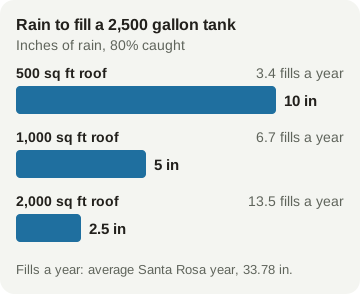
- A 1,000 square foot roof fills a 2,500 gallon tank in about 5 inches of rain. An average Santa Rosa year brings almost 34.
- Fire season is the dry season. Nothing refills the tank in summer. Our take: treat the fire reserve as off limits for the garden.
- It helps the ground too. Every gallon you catch in winter is one your well does not pump in summer. The Downspout shows how far Sonoma County groundwater has been drawn down.
- Want garden water too? Use a second tank, or a bigger one. The Downspout's rain barrel and tank guide covers sizes and permits.
- Permits: tanks over 5,000 gallons need county permits [2]. The state plumbing code's no-permit rule for rain tanks is written for garden watering [12], so ask Permit Sonoma about a fire tank.
Roof sprinklers: what they can and cannot do
Sprinkler systems that wet a house and roof before a fire arrives are sold for wildfire defense.
- The evidence is thin. IBHS, the insurance industry's research lab, says little methodical research exists on how well they work [5]. Fire Safe Marin says post-fire assessments have shown they can help [4].
- Garden sprinklers do not count. Fire Safe Marin calls them ineffective [4].
- They need water for hours. Embers could threaten a home for up to 8 hours [4].
- Wind and neighbors matter. High wind can carry the spray off target, and they may not help when the house next door is burning [4].
- Do not stay to turn them on. Fire Safe Marin does not recommend systems you must start by hand, because you should leave early [4]. See our go bag checklist.
- Never leave sprinklers running on town water. The Forestville Water District says sprinklers and hoses left on drain the supply firefighters depend on [6].
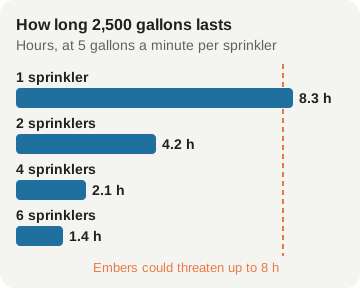
- Four sprinklers for 8 hours take about 9,600 gallons. That is almost four times the county's 2,500 gallon minimum.
- Our take: do not run sprinklers from the fire reserve. That water is for the crew. A sprinkler system needs its own supply.
- Plan for no power. Pumps need it, and fire weather brings shutoffs. See our power outage checklist. Our advice: backup power that starts on its own, such as a battery or an automatic standby generator. Do not plan on staying to start a pump.
- Harden the house first. Fire Safe Marin says hardening the home is likely to be more effective than any sprinkler, foam or gel, and to create defensible space before installing one [4]. Start with the first 5 feet.
What is on the market
- Installed, automatic systems. Frontline Wildfire Defense is one. Its system turns on when a fire is within 7 miles, after a 10 minute phone countdown, and sprays water mixed with Class A foam from roof and eave heads. It draws from the home's main water first, then switches to a pool, tank or well if pressure drops, and its controller has a backup battery. If pool or well water is used, the company says a dedicated pump with backup power is required [17]. The company says 59 of 61 homes with its system in and around the 2025 Los Angeles fires were saved. That figure is the company's own, and financing starts around $500 a month [18].
- Sprinkler kits. Portable kits, such as the WASP kit sold in Canada, clip sprinkler heads to the gutters and run from a garden hose tap [19].
- Our take. We have not tested any of these, and none is an endorsement. Ask any seller where the water comes from, how many gallons a minute it uses, and what runs it when the power is off. A system that starts on town water is drawing from the same supply firefighters need [6].
Ponds and pools
- A pond only helps if an engine can reach it. The 2025 California Wildland-Urban Interface Code requires an approved draft site at natural water meant for fire protection, reached from a road or a driveway no longer than 150 feet, without blocking the road [10].
- It has to hold water in fire season. Ponds lose a lot to summer evaporation. The Downspout's pond guide has the numbers, and the permits and water rights a pond needs.
- A supply that serves one house is exempt from the same code's 2 hour backup power rule for fire water pumps [10].
- Make a pond easy to use. A dry hydrant is a pipe from the pond to a hose connection by the road, so an engine can draft without driving to the water. An older USDA conservation standard from Indiana puts the intake below the drought-level pool with about 2 feet of water under it, behind a strainer, within 10 feet of an all-weather road, with no more than 20 feet of total lift, and calls for a yearly test with the fire department [15]. Ask your fire district before you build one.
- Helicopters. Some California water agencies have set up helicopter dip sites with fire agencies, beside their treatment plants and storage tanks [16]. We found no program for signing up a home pond.
- A pool is water too. Our advice: ask your fire district whether crews could reach and use it.
Next: set up the driveway side so an engine can get in. A Fire Ready Plan covers access, defensible space and the first 5 feet.
Can I register it with the fire department?
We did not find a countywide registry for private tanks, ponds or pools in Sonoma County.
What the county code does require is the hydrant and the blue marker, so crews can find it from the road [1].
Our advice: tell your fire district
| Water | What to tell them |
|---|---|
| Tank | Size, outlet size, where the hydrant and blue marker are |
| Pond | Whether an engine can reach it, and how full it gets by late summer |
| Pool | Size, and how close an engine can park |
Call the non-emergency line, never 911.
Grants and rebates
As of October 17, 2026, we did not find a current Sonoma County grant or rebate for home fire water tanks.
If you hear of one, use the "Something wrong on this page?" link below and we will add it.
What it means for you
Our take, in four steps:
- One full tank that a fire engine can hook up to beats a lot of gadgets.
- Let winter rain fill it, and keep it full through fire season.
- Mark it with a blue reflector and a hydrant by the driveway.
- Buy sprinklers last, after hardening and defensible space, with their own water and power.
Sources
- County of Sonoma: Fire Safety Ordinance, Chapter 13, Article V Fire Safe Standards, as amended August 11, 2020 (sections 13-24, 13-25, 13-50.1 to 13-53; read October 17, 2026)
- Permit Sonoma: Water Storage Tanks bulletin (revised August 2018) (permits over 5,000 gallons, NFPA 22, outlet size; read October 17, 2026)
- Water tank best practices for wildfire resiliency (2022), posted by Northern Sonoma County Fire (outlet, marker, clearance; read October 17, 2026)
- Fire Safe Marin: Exterior sprinklers and coatings (effectiveness, 8 hours, evacuate early; read October 17, 2026)
- IBHS: External sprinklers for wildfire defense (October 3, 2024) (limited research; read October 17, 2026)
- Forestville Water District: Preserving water for the fire fight (sprinklers left running; read October 17, 2026)
- Regional District of North Okanagan (British Columbia): Exterior Wildfire Sprinkler Fact Sheet (2024) (5 gallons a minute per sprinkler; read October 17, 2026)
- NOAA National Weather Service: Climate Station Precipitation Summary (Santa Rosa normal, 1991 to 2020; read October 17, 2026)
- Sonoma RCD: Slow it. Spread it. Sink it. Store it! (2015) (0.623 gallons per square foot per inch; read October 17, 2026)
- 2025 California Wildland-Urban Interface Code, section 404 (reproduction) (draft sites, pumper access, standby power; read October 17, 2026)
- AB 1750, Rainwater Capture Act of 2012 (Water Code 10574) (no water right for rooftop rainwater; read October 17, 2026)
- 2025 California Plumbing Code, section 1601.3 (reproduction) (permit exemptions for rain systems; read October 17, 2026)
- CAL FIRE San Luis Obispo Unit: Fire Safe Development in State Responsibility Areas (2023), quoting 14 CCR 1270 and 1275 (where the Fire Safe Regulations apply, hydrant and marker; read October 17, 2026)
- United Policyholders: California's Safer from Wildfires shows how to protect homes, get insurance discounts (2022) (the list of actions; read October 17, 2026)
- USDA NRCS Indiana: Conservation Practice Standard, Dry Hydrants, Code 432 (1999) (intake depth, strainer, road distance, lift, testing; read October 17, 2026)
- Association of California Water Agencies: member agencies assist in boosting firefighting (July 2024) (helicopter dip sites; read October 17, 2026)
- Frontline Wildfire Defense: How it works (activation, water source, foam, battery; read October 17, 2026)
- KTVU FOX 2: High-tech exterior sprinklers can save homes from wildfires (April 21, 2025) (company figures, cost; read October 17, 2026)
- Flash Wildfire Services: WASP full sprinkler kit (example of a portable kit; read October 17, 2026)