Defensible space inspection in Sonoma County: what inspectors check
Get your home ready before inspection season: what the county checks, what your insurer looks at, and a self-check to finish this winter.
Published November 5, 2026.
Being ready is the best way to avoid a fix notice, a reinspection fee and a surprise from your insurer. Outside city limits, Permit Sonoma and local fire districts inspect the land around homes for fire hazards. They do about 4,000 or more inspections a year. Inspections typically begin in late spring or early summer [1].
That includes the area right next to your house: roof debris, dead wood by the walls and things stored under decks can be flagged. It gives you the winter to get ready. Clearing now is easier than clearing in a rush in May.
Short answer
- What they look at: out to 100 feet from the home, or to your property line, and 10 feet from roads and driveways [1].
- What they want to see: lower tree limbs cut, brush removed or maintained, dead plants gone, and no leaves or debris against the house [1].
- If you fail: you get 30 calendar days to fix it, then a reinspection. A second failure can lead to a hearing [1].
- Your insurer looks too. It judges your house and the first 5 feet, mostly from aerial images and risk models. A home that is already ready is easier to keep insured.
This is the county's inspection program. Cities run their own, and your insurer has a separate list. Our guide Sonoma County fire rules: who checks what sorts those out.
What inspectors check
The county's inspection FAQ lists these hazards [1]:
- The zone. A radius of 100 feet from the home, or to the property line. Also 10 feet from roads and driveways.
- Ladder fuels. Trees with lower limbs cut. Brushy plants removed or maintained.
- Dead plants. Dead and dying vegetation removed.
- Debris. The house kept clear of leaves and other debris.
- Weeds and grass. Weeds, tall grass, brush and tree limbs that pose a fire hazard.
The exact heights and distances depend on your area. For the county's numbers, such as grass height and limb height, see our rules guide.
Your insurer checks too
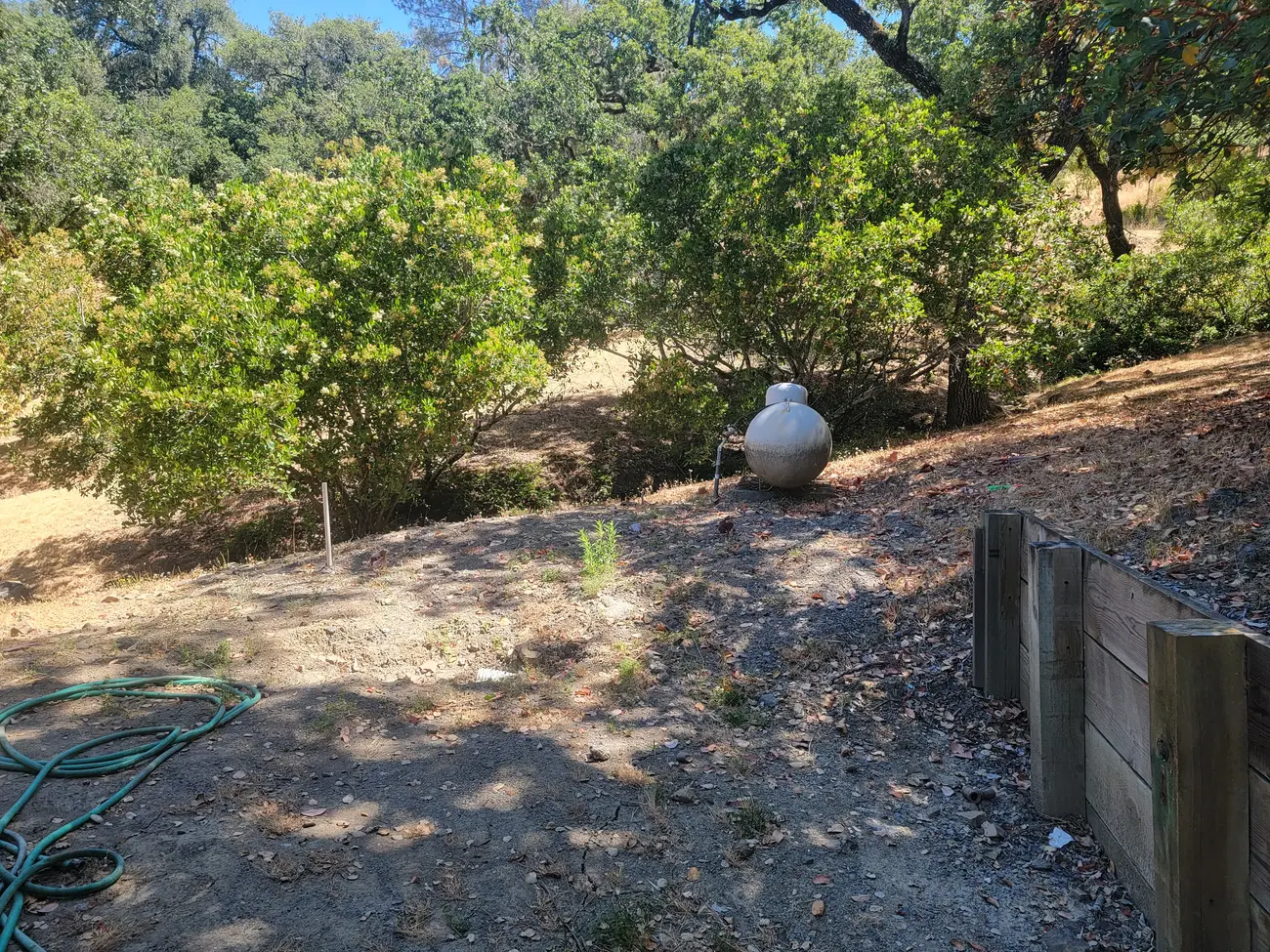
A county inspection is not the only one that matters. Insurers look at your house and the first 5 feet, mostly from aerial images and risk models. They can raise your price or decline to renew.
The same work that passes a county inspection helps with your insurer:
- California requires every insurer to offer discounts for listed wildfire work, such as a clear 5 feet [4] [5]. Discounts are modest. The bigger reason is staying insurable.
- IBHS Wildfire Prepared Home is a voluntary designation. Its checklist includes the first 5 feet and the house itself, such as vents and roof [6]. It does not guarantee coverage.
- If your insurer decides not to renew, it must tell you at least 75 days ahead, with the reasons. Starting in 2028, 90 days. You can ask for your wildfire risk score and how to lower it [5].
More in what each insurer asks for, the Wildfire Prepared Home checklist and what to do after a non-renewal.
Self-check you can do this winter
Walk your lot with a notepad. Start at the house and work outward.
- Roof, gutters and the base of the walls: sweep off leaves and needles [1]. See Clean gutters before the storms.
- The first 5 feet: clear dead wood from plants by the house, and clear plants and stored things from under decks and stairs. Move firewood out of the first 30 feet or cover it fully with fire-resistant material. Keep trees 10 feet from the chimney outlet. Why.
- Dead plants and dead limbs: mark them, then remove them.
- Brush under trees: remove or thin it so fire cannot climb.
- Lower tree limbs: cut them back. Hire a licensed, insured tree service for large limbs or anything near wires. See Trees near power lines.
- Roads and driveways: clear 10 feet from the edge [1].
- Take dated photos when you finish. They help if a notice comes.
Weeds and grass grow back in spring. The county says that if you cut vegetation before the deadline but growth returns before the inspection, you may be responsible for the reinspection fee [1]. Plan a second pass in late spring.
Want a second pair of eyes? Our Fire Ready Plan is an on-site walkthrough that checks defensible space out to 100 feet or your property line and gives you a ranked, priced plan. We are not a licensed contractor. Licensed work is done by licensed contractors you hire directly.
What happens if you fail (so you can avoid it)
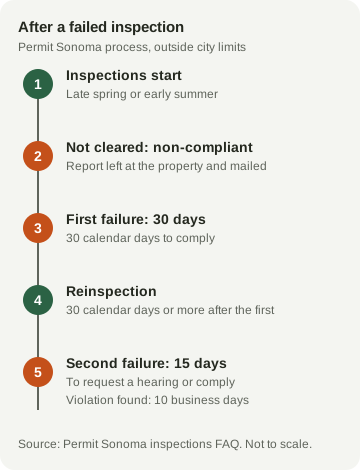
Owners who have not cleared hazards by the start of the inspection period will be found non-compliant [1]. The report is left at the property and mailed to the owner of record.
- Inspections start in late spring or early summer
- Not cleared: found non-compliant
- First failure: 30 calendar days to comply
- Reinspection 30 calendar days or more after the first
- Second failure: 15 calendar days to request a hearing or comply. If a hearing finds a violation, 10 business days to comply
The program is fee based. Once a reinspection has happened, the county says it cannot cancel the related fees, even if you finish the work later [1]. The FAQ does not list fee amounts. Ask the Fire Prevention Division.
Fire Prevention Division: FirePrevention@sonomacounty.gov or (707) 565-2361 [1]. You can also use the county's property lookup to see if your parcel is in the inspection area.
The first 5 feet: some of it can be flagged today
Zone 0 is the first 5 feet around a house. The Board of Forestry's Zone 0 rule is not in force. The Board adopted it August 19, 2026, and it was withdrawn from the Office of Administrative Law September 8 [2]. The Board adopted a revised rule on November 5, 2026. There is no start date yet [7].
That does not mean the ground next to your house is off limits to inspectors. Some near-house duties are already law wherever the 100-foot rule applies [3]:
- Roof: free of leaves, needles and other plant debris.
- Chimney: no part of a tree within 10 feet of the outlet.
- Dead wood: none on plants next to or over the house.
- Under decks and stairs: cleared of plants and stored things that burn.
- Firewood: out of the first 30 feet, unless fully covered with fire-resistant material.
Any of these can be written up on an inspection. What the proposed Board of Forestry rule would add, such as banning bark mulch next to the wall, is not law today. Our rules guide sorts the layers: law now, coming, and what insurers ask. More on the Board of Forestry rule in our Zone 0 guide and on our sister site, Zone Zero Guidelines. For email alerts when it changes, see Zone Zero Watch.
Who this applies to
Homeowners outside city limits in Sonoma County, where Permit Sonoma and fire districts inspect. Inside a city, your city fire department runs the program. Use our fire hazard zone check to see where you sit.
Rules change. Confirm with Permit Sonoma or your local fire authority. This is general information, not legal advice.
Related
- Sonoma County fire rules: who checks what
- Zone 0 rules in Sonoma County
- Trees near power lines
- Home Ready Sonoma
Sources
- Permit Sonoma: Hazardous Vegetation Inspections FAQs (accessed November 5, 2026)
- Office of Administrative Law: Recent Actions on Emergency Regulations (file 2026-0828-03E)
- Public Resources Code 4291 (defensible space)
- Safer from Wildfires, California Department of Insurance
- FAQ on the Safer from Wildfires regulation, California Department of Insurance (PDF)
- Wildfire Prepared Home requirements summary, IBHS
- Board of Forestry: Notice of emergency action, Zone 0 (November 2026, PDF)