Atmospheric river categories: what AR 1 to AR 5 mean for your home
Atmospheric river categories rate a storm from AR 1 to AR 5. Here is what each category means, why a long storm rates higher, and what to do at your house before an AR 3 or stronger.
The short answer
- An atmospheric river is a long, narrow band of water vapor in the sky [1]. A strong one can bring extreme rain, most of all when it stalls over one area [1].
- Atmospheric river categories go from AR 1 (weak) to AR 5 (exceptional) [3].
- The rating depends on two things: how much water vapor the storm carries and how long it stays over one place [3][4].
- AR 1 is primarily beneficial, for example by refilling reservoirs. AR 5 is primarily hazardous [3].
- What to do: keep up with gutters and drains all winter. When a forecast shows AR 3 or higher, take the steps below a day or two ahead.
What an atmospheric river is
NOAA, the federal weather and ocean agency, calls atmospheric rivers relatively long, narrow regions in the atmosphere that carry most of the water vapor outside the tropics [1].
An average one carries about as much water as the Mississippi River pours out at its mouth. A very strong one can carry up to 15 times that [1].
A strong one that carries moisture from near Hawaii to the West Coast is often called a Pineapple Express [1].
They matter a lot here. Atmospheric rivers can bring up to half of California's yearly rain and snow [2]. They can also stall over a watershed and cause floods and mudslides [1].
The five atmospheric river categories
Each category says how much good and how much harm to expect [3]:
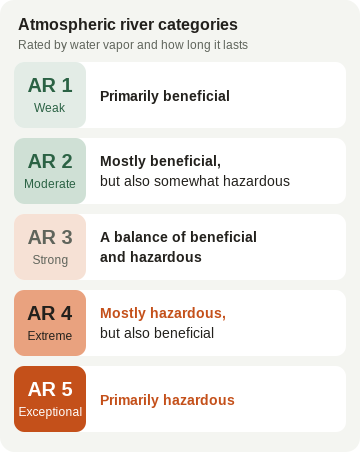
- AR 1, weak. Example: February 2, 2017. About a day at the California coast, modest rain.
- AR 2, moderate. Example: November 19 to 20, 2016, Northern California. 42 hours, several inches of rain that helped refill low reservoirs.
- AR 3, strong. Example: October 14 to 15, 2016. 36 hours, 5 to 10 inches of rain. Some rivers came close to flood stage.
- AR 4, extreme. Example: January 8 to 9, 2017. 36 hours, up to 14 inches of rain in the Sierra Nevada. At least a dozen rivers reached flood stage.
- AR 5, exceptional. Example: December 29, 1996 to January 2, 1997. Over 100 hours at the Central California coast, more than $1 billion in damage.
In short: AR 1 and AR 2 mostly help. AR 3 is a balance. AR 4 and AR 5 do more harm than good.
Why a long storm rates higher
The scale counts time, not just strength. A storm that lasts 24 to 48 hours over one place keeps the category its strength gives it [3].
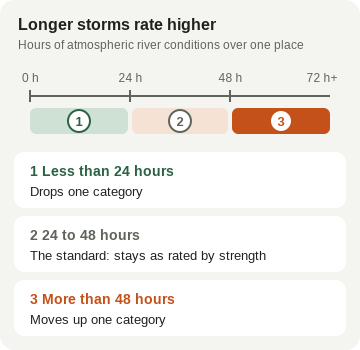
- Less than 24 hours: drops one category.
- 24 to 48 hours: stays as rated by strength.
- More than 48 hours: moves up one category.
So a storm of the same strength rates one step higher if it hangs over Sonoma County for three days, and one step lower if it passes in less than a day. That fits what the county warns about: prolonged rain events, flooding and storm drains that overflow [5].
Where to see the category in a forecast
CW3E posts atmospheric river scale forecasts for the West Coast. The page shows forecasts from several weather models, updated every 6 to 24 hours depending on the model [4].
Treat the category as a heads-up. For what to do and when, follow the National Weather Service and county alerts [5].
What to do at home, by category
This is our take. The categories don't come with official home checklists.
Any storm, AR 1 and up
- Keep gutters and downspouts clear, and make sure the water lands away from the house. See our gutters guide.
- Clear the drain and culvert at your driveway of leaves and branches.
- Sign up for SoCoAlert with every phone in the house [5].
AR 3: a day or two ahead
- Walk around the house on a dry day. Look for low spots where water has pooled before, and for doors at or below ground level.
- Get sandbags ready if water has come in before. The county lists free sand and bag sites [6]. Our sandbag guide shows how to fill and place them.
- Plan for a power outage. Charge phones and battery packs. See our power outage checklist.
- Move things off the floor in the garage and any space under the house that has taken water before.
- Tie down or bring in patio furniture, trash cans and anything wind can throw. Our high winds guide has the list.
AR 4 or AR 5: be ready to leave
- Know your evacuation zone and how you would get out. See Sonoma County evacuation zones.
- Pack a go bag with medicines, documents and chargers. Our go bag checklist works for storms too.
- Live on or below a steep slope, or below a burn scar? The county warns that heavy rain on saturated hillsides and recent burn scars raises the risk of landslides [5]. Learn the landslide warning signs.
- Near the coast or the bay? Big storms plus high tides can bring coastal flooding and erosion [5]. See our king tides guide.
Check your insurance before the big one
The California Department of Insurance says homeowners policies typically exclude flood, mudslide and debris flow [7]. If water from a storm could reach your house, ask your agent what your policy covers before the season's big storms.
A home inventory made now makes any claim easier later.
Who this applies to
- Every Sonoma County homeowner who hears "atmospheric river" in a forecast and wants to know how worried to be.
- Homes near the Russian River, creeks or low roads, where long storms matter most.
- Homes on hillsides or below burn scars, because of landslide risk [5].
- Renters: the steps work for you too. Tell your landlord about clogged gutters or drains before the storm.
Related
- Sonoma County storm update
- El Niño 2026-27: what it means for Sonoma County
- Sonoma County sandbags
- Free storm help in Sonoma County
- Winter storm checklist for Sonoma County homes
- Home Ready Sonoma home
Sources
- NOAA: What are atmospheric rivers? (definition, Mississippi River comparison, up to 15 times for strong ones, Pineapple Express, floods and mudslides; read November 27, 2026)
- U.S. Geological Survey: Rivers in the Sky, 6 facts you should know about atmospheric rivers (December 14, 2021; up to 50% of California's yearly precipitation; read November 27, 2026)
- U.S. Geological Survey: New scale to characterize strength and impacts of atmospheric river storms (February 11, 2019; AR 1 to AR 5 labels, beneficial and hazardous wording, example storms, 24 to 48 hour standard, one category down under 24 hours and up over 48 hours; read November 27, 2026)
- CW3E, UC San Diego: Atmospheric River Scale Forecasts (scale set by duration and peak water vapor transport; model forecasts updated every 6 hours, about 12 hours, or daily; read November 27, 2026)
- County of Sonoma: El Niño and Winter Storms (prolonged rain, flooding and drainage overflow, landslides on saturated hillsides and burn scars, coastal erosion with high tides, SoCoAlert and Nixle; snapshot November 26, 2026)
- County of Sonoma: Sandbags (free sand and bag sites during storms; checked November 24, 2026)
- California Department of Insurance: Commissioner alerts consumers about insurance coverage following winter storms (2025; homeowners policies typically exclude flood, mudslide and debris flow; read November 25, 2026)